Why Your Long Run Pace Drops When the Weather Finally Cools
Quick Answer: Cool weather does improve running performance for most people, so a slower long run usually points elsewhere - most commonly accumulated training load from a build phase peaking around now, an inadequate warm-up in cold conditions, under-hydration because thirst drops in the cold, or fuelling that has not kept pace with longer runs. Check those four before concluding you have lost fitness.
All summer you told yourself the heat was costing you a chunk of pace. The heat left, and the pace did not come back, which is a specific and demoralising kind of confusing.

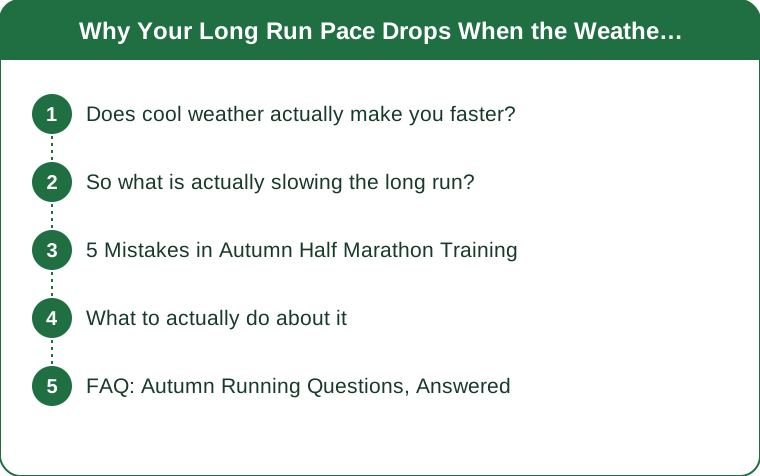
Does cool weather actually make you faster?
For most runners, yes - within a range.
Heat is a well-documented performance cost. Endurance performance declines as ambient temperature rises above a relatively modest threshold, because a growing share of cardiac output goes to skin blood flow for cooling rather than to working muscle, and core temperature rise itself limits output.
The optimum for endurance running is generally cool rather than cold - somewhere in the region of 5 to 12°C for many runners, though it varies with individual, clothing, and effort. Marathon performances at the elite level cluster in cool conditions for exactly this reason.
Below that range, performance starts to decline again. Very cold air increases the energy cost of running slightly, muscles are less efficient when cold, and the extra clothing adds weight and restricts movement. Genuinely cold conditions are not faster than cool ones.
Which means the benefit is real but bounded. If you are running in 3°C and expecting the full cool-weather benefit, some of it has already gone.
And the effect on perceived effort is larger than the effect on pace for many people - running feels much better in cool weather, which is why the disappointment when the pace does not follow is so pronounced.
One genuine seasonal cost: if your route now includes wet leaves, mud, or darkness, the surface and visibility both slow you legitimately, and that has nothing to do with fitness.
So what is actually slowing the long run?
Four candidates, in rough order of likelihood.
Accumulated fatigue from the training block. If you have been building through summer for an autumn race, October is often the highest-load period of the plan. Long runs during peak weeks are supposed to feel harder, and pace on tired legs is not a measure of fitness. This is the most common explanation and the easiest to mistake for lost fitness.
An inadequate warm-up. In summer you were warm before you started. In autumn you are not, and cold muscles are less compliant and less efficient. The first two or three kilometres of a cold-weather run are legitimately slower, which drags the average down even if the rest is fine.
Under-hydration. Thirst is a weaker signal in cool weather, and people drink noticeably less. You still lose fluid through sweat and through respiration in dry cold air, and even modest dehydration affects endurance performance.
Fuelling that has not scaled with the runs. As long runs extend into the two-hour range and beyond, carbohydrate intake during the run becomes significant rather than optional. Runs that were fine unfuelled at 90 minutes in July are a different proposition at 130 minutes in October.
Two more worth checking. Sleep, which often deteriorates as the season and schedule change and directly affects performance. And illness - the autumn respiratory season means many runners are training through the early stages of something without recognising it.
And a measurement issue: if you have moved from a flat summer route to a hillier or softer autumn one, or from daylight to darkness, you are not comparing like with like at all.

5 Mistakes in Autumn Half Marathon Training
1. Judging fitness by long run pace during a peak block. Long runs in the highest-volume weeks of a plan are run on fatigued legs by design. Pace there tells you about accumulated load, not about race capability. The taper exists precisely because of this.
2. Skipping the warm-up because the run itself is the warm-up. In cold conditions, starting a long run cold means the first several kilometres are inefficient and uncomfortable, and it raises injury risk in a season where that risk is already elevated. Five minutes of easy movement before starting changes the whole run.
3. Under-drinking because it is cold. Thirst is unreliable in cool weather and fluid loss continues, including through breathing dry cold air. Carry fluid on long runs the way you did in summer, and drink to a plan rather than to thirst.
4. Racing the easy runs. Cool weather makes easy runs feel effortless, and it is very tempting to speed them up. Doing so raises overall load in the block where load is already highest, and the cost shows up in the long run at the weekend. Easy should stay easy.
5. Not adjusting clothing for the pace you will settle into. Dressing for the temperature at the start means overdressing by kilometre three. The standard guidance is to dress as if it were around 10°C warmer than it is, which feels wrong standing outside your front door and is right ten minutes later.
And the seasonal one people forget: darkness. Running the same route at dusk rather than in daylight is slower and it should be - uneven surfaces, wet leaves, and reduced visibility all justify caution. A head torch and reflective kit are training equipment in autumn, not optional extras.
What to actually do about it
Diagnose before adjusting.
Check where you are in the plan. If this is a peak-volume week, a slow long run is expected and the correct response is to keep going and trust the taper. If it is an easy week and the pace is still down, look further.
Compare like with like. Same route, same time of day, same conditions, same point in the week. Comparing a hilly dark October long run against a flat July morning one tells you nothing.
Add a proper warm-up. Ten minutes of walking and easy jogging before the run proper. Start the long run at a deliberately conservative pace for the first two kilometres.
Fix hydration and fuelling deliberately. Carry fluid. Take carbohydrate on anything beyond around an hour to ninety minutes, and practise the fuelling strategy you intend to use on race day, because race day fuelling is a skill that needs rehearsal.
Check sleep honestly. A week of poor sleep affects long runs more than most people expect, and autumn schedule changes disrupt sleep for many.
Consider whether you need a down week. If several sessions in a row have been below par, and sleep and fuelling are fine, accumulated fatigue is the likely answer and a reduced week usually restores things quickly.
And use effort rather than pace as the primary guide in this phase. Running long runs by feel, at a genuinely conversational effort, is more reliable than chasing a pace target through variable autumn conditions.
Persistent fatigue, a sudden significant drop in performance, or unusual breathlessness are worth discussing with a GP rather than training through. This is general information, not medical advice.
FAQ: Autumn Running Questions, Answered
Is running faster in cold weather?
Up to a point. Endurance performance generally improves as temperatures fall from hot into a cool range - roughly 5 to 12°C suits many runners - because less cardiac output is diverted to cooling. Below that, performance declines again as muscles work less efficiently when cold and extra clothing adds weight and restriction.
Why am I slower now that it has cooled down?
Most commonly accumulated training load, since October is often the peak of an autumn race build. Then an inadequate warm-up in cold conditions, under-hydration because thirst drops, and fuelling that has not scaled with longer runs. Check those four before concluding anything about fitness.
Do I still need to drink on runs in cold weather?
Yes. You continue to lose fluid through sweat and through respiration, and dry cold air increases respiratory water loss. Thirst is a weaker cue in the cold, so drink to a plan rather than waiting to feel thirsty - under-drinking is one of the most common autumn training errors.
How should I dress for a long run in autumn?
As if it were about 10°C warmer than it actually is. You will feel underdressed standing outside and correct within ten minutes of running. A thin layer you can tie around your waist, plus gloves and a hat, covers most autumn conditions.
Should I worry if my long run pace is down during peak training weeks?
No - long runs in the highest-volume phase of a plan are run on tired legs by design, and pace there is a poor measure of race fitness. That is exactly what the taper addresses. Persistent poor performance across an easy week is more informative than one hard long run.
TL;DR:
- Cool weather does help, but the optimum is cool rather than cold, and the benefit is bounded.
- The usual culprit is accumulated load - long runs in peak weeks are supposed to feel hard.
- Cold muscles make the first few kilometres legitimately slow; warm up before you start.
- Thirst drops in the cold but fluid loss does not - drink to a plan, not to thirst.
- Dress as if it were 10°C warmer, and run long runs by effort rather than chasing a pace.
The heat was costing you something. It is just that the training block replaced it with a different and more productive kind of tiredness.
Keep Reading
This article is for general informational purposes only and is not medical advice. Always consult a qualified health professional for guidance specific to you.