Why Your Long Run and Your Race Pace Stop Agreeing Mid-Block
Quick Answer: Long runs and threshold work draw on different systems and recover on different timelines. Mid-block, accumulated fatigue usually degrades one before the other — most often it is speed that goes first, because threshold work is more sensitive to glycogen depletion and neuromuscular fatigue. The fix is usually distribution and recovery, not more training.
You are six weeks into a twelve-week block. The long run on Sunday felt controlled and strong.
On Tuesday you could not hold a pace you were comfortably running in week two. Nothing about your fitness has gone backwards — but something has definitely changed.

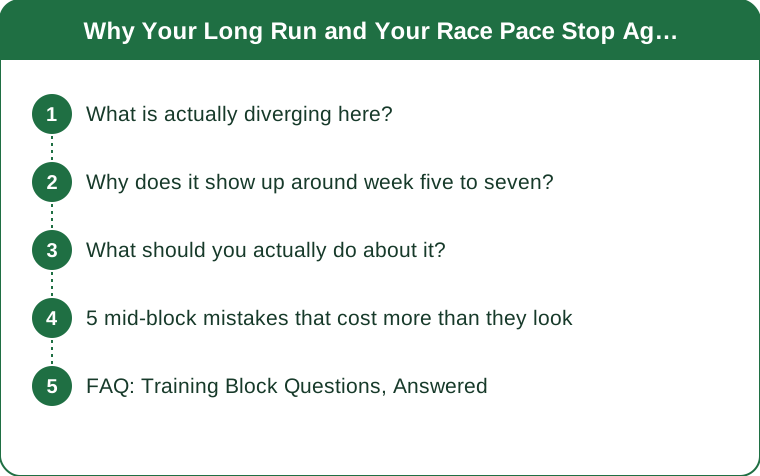
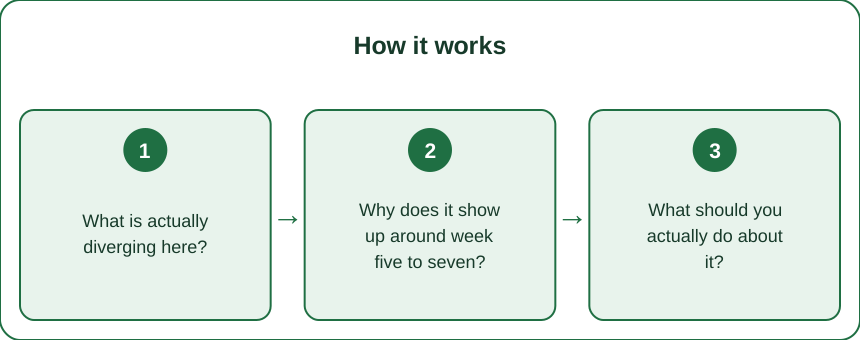
What is actually diverging here?
Two different qualities that improve on different schedules and fatigue on different schedules.
Aerobic endurance — the ability to sustain moderate effort for a long time — is built by capillary density, mitochondrial volume, fat oxidation capacity, and structural tolerance in muscle and connective tissue. These adapt slowly and are relatively resistant to short-term fatigue. A tired runner can usually still complete a long easy run reasonably well.
Threshold and speed work depend on different things: glycogen availability, buffering capacity, neuromuscular recruitment, and freshness. All of these degrade quickly under accumulated load. Two weeks of high volume with insufficient carbohydrate and you can lose 10 to 20 seconds per kilometre at threshold while your easy pace is unaffected.
That is the divergence. The long run is testing a system that hides fatigue well, and the tempo run is testing one that reports fatigue immediately.
Which is why the pattern is diagnostic rather than alarming. When the long run holds and the speed goes, that is the signature of accumulated fatigue, not lost fitness. When the reverse happens — speed intact, long runs collapsing — the usual causes are different: fuelling on the run, heat, or ramping long-run distance faster than the connective tissue is adapting.
Why does it show up around week five to seven?
Because that is where the arithmetic of a standard block puts peak accumulated load relative to recovery capacity.
Most twelve-week plans build for three weeks, ease for one, then build again from a higher base. By week five or six you are running the highest volume of your life so far while carrying residual fatigue from the previous block. Adaptation from those weeks has not yet been expressed — training effect typically shows up 10 to 21 days after the work that caused it.
Meanwhile the other inputs have often quietly degraded. Sleep tends to shorten as the plan takes over the calendar. Carbohydrate intake frequently fails to scale with volume, because appetite lags behind expenditure. A runner who added 25 percent to their weekly volume and nothing to their weekly carbohydrate is running progressively more depleted every week, and threshold work is where that shows first.
Late-season heat plays a role too. Running in warm, humid conditions raises heart rate at any given pace by five to ten beats and increases perceived effort substantially. A tempo pace set in May is genuinely harder in a warm August, and it is easy to interpret that as regression.
The reassuring version of all this: week six of a twelve-week block is supposed to feel hard. That is what the taper is for.

What should you actually do about it?
In order of what to try first.
Take an unscheduled easy week. Cut volume by 30 to 40 percent for seven days, keep one short session at intensity to hold the neuromuscular quality, and re-test. If the speed comes back, it was fatigue and you have your answer for the rest of the block.
Fix carbohydrate before fixing training. During heavy weeks, aim for meaningfully more carbohydrate on hard days than easy ones — most half-marathon runners under-fuel the day before a quality session rather than the session itself. If your tempo pace collapses in the last third of the session specifically, that is a fuelling signature.
Move the tempo session further from the long run. Tuesday tempo after a Sunday long run gives roughly 40 hours of recovery. Wednesday gives 64, and for many people that is the entire difference.
Run the tempo by effort, not by pace, for two weeks. Pace targets set in cool spring conditions are not valid in late-summer heat and humidity. Using effort or heart rate keeps the physiological stimulus correct while conditions vary.
Check the easy runs are actually easy. The most common cause of failed quality sessions is easy days run 20 to 30 seconds per kilometre too fast.
5 mid-block mistakes that cost more than they look
1. Adding a session to compensate for a bad one. A failed tempo means you were too tired. Adding volume to a fatigued athlete produces a worse athlete, reliably.
2. Testing your fitness in the middle of a block. Race-pace time trials during peak load will always disappoint, because you are not tapered. All they generate is discouragement based on invalid data.
3. Skipping the down week because you feel fine. The down week exists to let adaptation express. Feeling fine during peak load usually means the fatigue has not caught up yet, not that you have escaped it.
4. Chasing the plan’s paces after a poor week. Plans are written for an idealised athlete who slept eight hours a night. Adjusting paces down by 3 to 5 percent for a week is normal management, not failure.
5. Ignoring the long run’s warning signs. The third one catches most people, but this is the expensive one — if the long run has started to hurt in a joint-specific way rather than feeling generally tired, that is a structural signal and it does not resolve by pushing through.
FAQ: Training Block Questions, Answered
Should I be worried if my race pace feels impossible in week seven?
No, provided the long runs are still going reasonably. Race pace should feel hard and slightly improbable during peak load. It becomes achievable during the taper, which is precisely what a taper is for — most runners gain 2 to 3 percent from it.
How much should I cut for an unscheduled easy week?
About 30 to 40 percent of weekly volume, keeping frequency the same and shortening runs rather than dropping days. Keep one session with 10 to 15 minutes at moderate intensity so you do not lose the sharpness you are trying to protect.
When is fatigue actually overtraining rather than normal block fatigue?
Warning signs are elevated resting heart rate over several days, disturbed sleep, persistent low mood, frequent minor illness, and appetite loss. Normal block fatigue resolves with an easy week; overreaching that has gone too far does not. If a proper easy week does not restore your paces, see a sports physician rather than pushing on. This is general information, not medical advice.
TL;DR:
- Long runs and threshold sessions fatigue on different timelines — speed degrading while endurance holds is the classic accumulated-fatigue signature.
- Week five to seven is where load peaks and adaptation has not yet expressed; it is meant to feel hard.
- Try an easy week, more carbohydrate on hard days, and more spacing between the long run and the tempo before changing the plan.
- Run tempo by effort in warm weather; spring pace targets are not valid in late summer.
The block is not falling apart. It is doing the thing that makes the taper work — and the taper is where the pace you are missing comes back.
Keep Reading
This article is for general informational purposes only and is not medical advice. Always consult a qualified health professional for guidance specific to you.