Why Your Race Shoes Feel Different on Race Day Than They Ever Did in Training
Quick Answer: Race pace loads the shoe differently than training pace, cold morning air stiffens midsole foam, your feet swell more over a race distance than a training run, and tapered legs land differently than tired ones. The result is a familiar shoe behaving unfamiliarly. Fix it by doing at least two race-pace efforts in the exact race shoes, lacing for the swelling you will have at mile ten rather than the foot you have at the start line, and warming the shoes in your hands or under your jacket before a cold start.
You ran two hundred miles in these. They were perfect.
Mile three of the race and something is unmistakably different, and you cannot work out what.

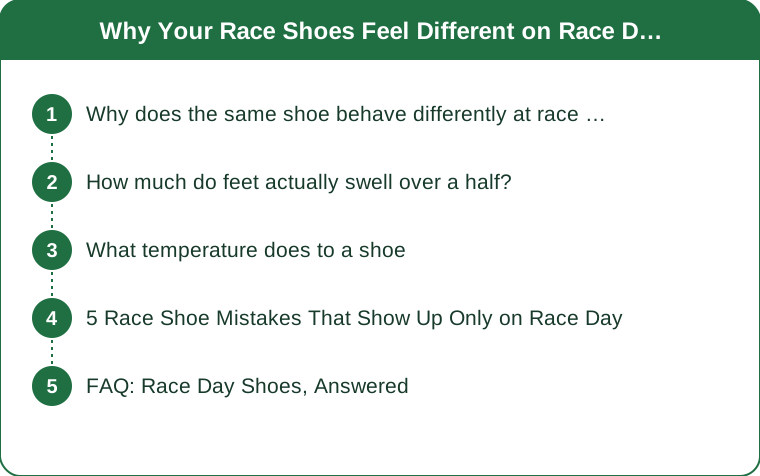
Why does the same shoe behave differently at race pace?
Foam responds to load rate, not just load. Running faster means striking the ground harder and for less time, and midsole foams compress and rebound differently under that changed input. A shoe tuned for tempo pace genuinely feels different at easy pace and vice versa.
Your footstrike shifts with speed. Most runners land further forward as pace increases, which means you are loading a different part of the shoe than the part you broke in over months of easy running.
Plated and highly rebounding shoes amplify this. A carbon or nylon plate has a stiffness that interacts with cadence and pace, and its behaviour at race effort can feel almost like a different shoe than it did on a shakeout run.
Tapered legs land differently. After a taper you are fresher, more elastic, and striking with more force than in your fatigued training weeks. This is a good problem and it still changes the sensation underfoot.
Race pace also changes your cadence, which changes ground contact time, which changes how much the foam has time to rebound. Everything downstream of speed feeds back into how the shoe feels.
And adrenaline blunts proprioception at the start, so the first two miles regularly feel odd in shoes that will feel completely normal by mile six.
How much do feet actually swell over a half?
Meaningfully - enough to change fit by a half size in some runners over 13.1 miles, particularly in warm conditions. Blood flow increases, fluid accumulates, and the foot spreads under repeated loading.
Training runs rarely reach that point. Most weekly runs are shorter than race distance and run at a pace that generates less swelling, so the fit you know is the fit at mile six rather than mile eleven.
Heat multiplies it. A warm race produces noticeably more swelling than a cool one, which is why the same shoes can feel roomy in October and tight in August.
The consequence lands in the toe box and the midfoot, appearing as toe pressure or as laces feeling suddenly tight around mile eight to ten.
Lace for the foot you will have, not the one at the start. Slightly looser through the midfoot with a secure heel lock is a better setup for a half than a snug start-line fit.
Runner’s loop lacing at the top eyelet holds the heel without tightening the midfoot, which is the single most useful lacing adjustment for this problem.
And leave a full thumb’s width at the toe in any shoe you intend to race a half in. Fit that is perfect standing still in a shop is usually too small at mile ten.

What temperature does to a shoe
Midsole foam stiffens in the cold, measurably. A shoe that felt soft on a warm training afternoon can feel firm and unresponsive at a seven-in-the-morning start in autumn, and this is a genuine material property rather than a perception.
Supercritical foams are the most temperature-sensitive, which is exactly the category most modern race shoes fall into. The softest, bounciest shoes tend to lose the most in the cold.
Warm the shoes before the start. Keep them under a jacket, in a bag next to you, or on your feet inside for twenty minutes rather than pulling them cold out of a car boot at the start line.
A proper warm-up warms the shoe too, which is one of the underappreciated benefits of a fifteen-minute jog before a race in cool weather.
Cold also affects your foot, which is less compliant and less sensitive when cold, adding to the impression of a stiff shoe. Both variables move in the same direction and compound.
Now that mornings are cooling toward autumn race season, this matters more than it did in the summer build-up - and it is the most common reason a shoe that felt perfect in August feels dead at a September start line.
And the effect fades within a couple of miles as both foam and foot warm up. If the shoe feels wrong at mile one on a cold morning, give it until mile three before concluding anything.
5 Race Shoe Mistakes That Show Up Only on Race Day
1. Racing in shoes you have only run easy in. The shoe you know at easy pace is not the shoe you get at race pace. Do at least two race-pace sessions in the exact pair.
2. Brand-new shoes on race day. Even the same model in a new pair differs slightly, and manufacturing variation is real. Twenty to forty miles is a sensible minimum before racing a pair.
3. Lacing tight at the start line. It feels secure and it is the setup that produces numb toes and hot spots at mile ten as your feet swell. Lace slightly loose through the midfoot with a firm heel lock.
4. New socks. The most overlooked variable in the whole system. Sock thickness changes fit as much as a half size, and a new pair on race day is an untested change to a tested setup.
5. Cold shoes straight from a car. Foam stiffness is temperature-dependent, and starting a cool race in shoes that have been in a boot overnight guarantees the first miles feel wrong.
And the mistake behind all five: treating the shoe as a fixed object rather than a system that includes pace, temperature, socks, lacing, and how swollen your feet are. Change any one of those and the shoe changes with it.
FAQ: Race Day Shoes, Answered
Why do my race shoes feel different on race day?
Race pace loads the foam differently, cold air stiffens the midsole, your feet swell more than in training, and tapered legs strike harder. All four move at once, so a familiar shoe feels unfamiliar.
How many miles should a race shoe have before race day?
At least twenty to forty, including two sessions at your goal race pace. Racing in a pair you have only run easy in is the most common version of this problem.
How should I lace for a half marathon?
Slightly loose through the midfoot with a runner’s loop at the top eyelet for heel security. Your feet will be bigger at mile ten than at the start line.
Should I size up for racing?
Leave a full thumb’s width at the toe. Whether that means sizing up depends on the shoe, but a fit that is perfect standing still is usually too small by mile ten.
Does cold weather really change how a shoe feels?
Yes. Midsole foams stiffen at low temperatures, and supercritical race foams are the most affected. Warm the shoes before the start and give them a couple of miles to come back.
The shoes feel wrong at mile one - should I worry?
Usually not. Adrenaline, cold foam, and cold feet all peak at the start. Give it until mile three before making any judgement, and never make a shoe decision in the first mile.
TL;DR:
- Race pace, cold foam, foot swell, and fresh tapered legs all change how a familiar shoe feels.
- Do at least two race-pace sessions in the exact pair, with twenty to forty miles on them before race day.
- Lace slightly loose through the midfoot with a runner’s loop heel lock - your feet will be bigger at mile ten.
- Warm the shoes before a cool start; supercritical race foams stiffen noticeably in the cold.
- Never change socks on race day, and never judge a shoe in the first mile.
The shoe is a system, not an object. Change the pace or the temperature and you have changed the shoe.
Keep Reading
This article is for general informational purposes only and is not medical advice. Always consult a qualified health professional for guidance specific to you.