How to Rebuild a Half Marathon Plan After Two Missed Weeks
Quick Answer: After two missed weeks, do not resume where the plan says you should be. Return at roughly 70 to 80 percent of your previous weekly volume, rebuild over two weeks, and cut one hard session rather than the long run. Aerobic fitness declines slowly — meaningful losses take longer than two weeks — so the risk on return is injury from a sudden load jump, not lost fitness.
The plan is a tool, not a contract.
This is general information, not medical advice.

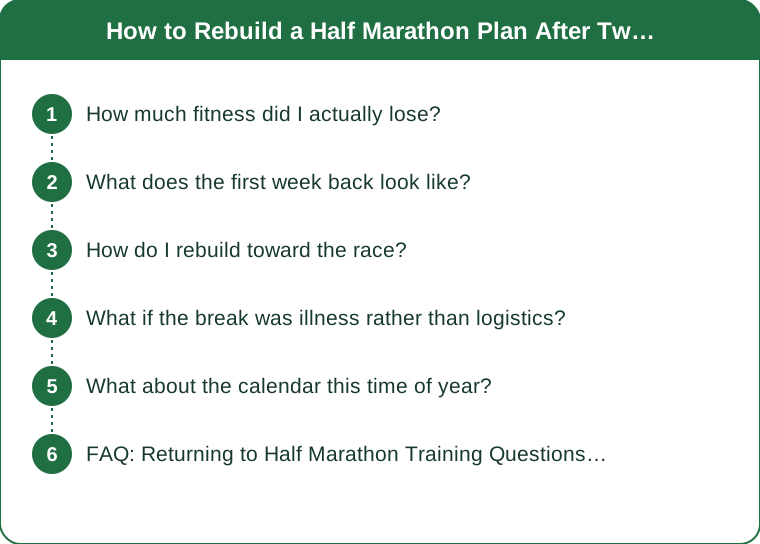
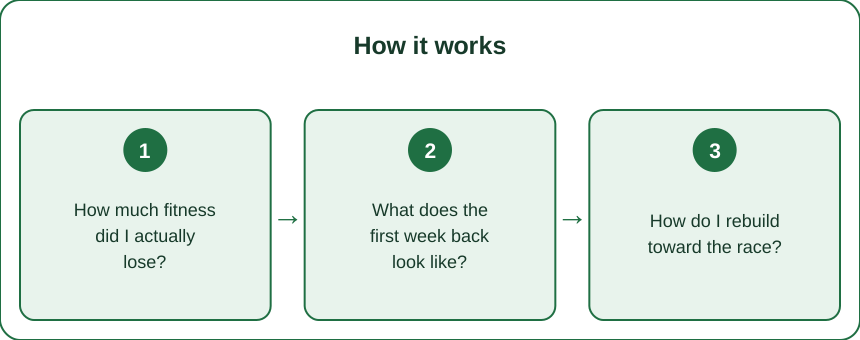
How much fitness did I actually lose?
Less than it feels like. Detraining research consistently shows that endurance markers hold up reasonably well over a couple of weeks of reduced training, and decline much faster after that.
Two weeks off completely is different from two weeks reduced. If you ran even a couple of times, the losses are smaller still.
Your legs will feel worse than your fitness is. Running-specific muscular tolerance and neuromuscular coordination fade before the cardiovascular system does, which is why the first run back feels much harder than the numbers justify.
Blood volume drops relatively quickly and returns within a week or two of resuming, which explains a large part of the elevated heart rate on early runs back.
What does the first week back look like?
Start at roughly 70 percent of your last normal week’s mileage. Not the week you were supposed to be doing — the last one you actually completed.
All easy, conversational pace. No intervals, no tempo, no time trial to see where you are. That test costs more than the information it gives.
Keep the long run, but shorten it. Around 70 percent of your previous longest run, at an easy effort, is the right target.
Add one extra rest day. The temptation is to run more to catch up; the useful move is to run the same days at lower volume.
Expect elevated heart rate at the usual pace. That is normal and resolves in one to two weeks. Run by effort, not by pace, through this period.
How do I rebuild toward the race?
Week two: back to about 85 to 90 percent. Reintroduce one quality session, and make it strides or a short tempo rather than a full interval workout.
Week three: normal volume, normal structure. Most people are fully back by here after a two-week gap.
Do not try to make up missed long runs. Two long runs in one week is the classic post-break injury pattern. Progress the long run by no more than about 10 to 15 percent per week.
Recalculate the goal, honestly. If the break was inside the final six weeks, the realistic outcome shifts. That is worth accepting early rather than discovering at mile 10.
Protect the taper. The single worst response to a break is to compress training and shorten the taper. The taper is where the work becomes available to you.

What if the break was illness rather than logistics?
Above-the-neck symptoms, resolved: gentle return is generally fine. Below-the-neck symptoms, fever, or chest involvement need a slower and more cautious return, and medical advice if there is any doubt.
Return at a lower intensity than after a logistics break. Illness costs more than time off alone, particularly if there was fever.
Watch heart rate at easy effort for a week. A resting or easy-run heart rate that stays substantially elevated is a reason to slow down further, not to push through.
Any chest pain, unusual breathlessness, or palpitations on returning to exercise after illness warrants medical assessment before continuing. This is not the place for judgement calls.
What about the calendar this time of year?
Late August into September is peak autumn-race build season, which means a break now lands in the middle of the highest-volume block for most plans.
Cooling weather works in your favour on return. Paces that felt hard in August humidity come more easily as temperatures drop, which can mask how much load you are adding. Go by effort, not by the encouraging pace numbers.
Darker mornings change the practical plan. If the missed weeks pushed sessions later, check that the schedule you are rebuilding into is one you can actually run in the light available.
If the race is more than eight weeks out, a two-week break is close to irrelevant. Rebuild calmly and continue the plan from where the body is.
If it is under four weeks out, treat the remaining time as a taper with a couple of quality touches, not as a compressed training block.
FAQ: Returning to Half Marathon Training Questions, Answered
Should I move my race?
If the break was under three weeks and the race is over six weeks away, usually no. If the break was longer or the race is close, adjusting the goal time is often the better move than moving the date.
Can I cross-train to catch up?
Cross-training maintains aerobic fitness well and does not rebuild running-specific tolerance. It is a useful supplement during the return, not a substitute for gradual running load.
How do I know if I came back too fast?
Persistent soreness lasting more than two days, a niggle that appears at the same point in every run, or fatigue that increases week on week. Any of those means cutting back for a week rather than pushing on.
TL;DR:
- Two weeks off costs far less aerobic fitness than it feels like.
- Return at 70 percent of your last real week, all easy, with one extra rest day.
- Rebuild to 85 to 90 percent in week two and normal in week three.
- Never double up long runs to catch up — that is the classic injury pattern.
- Illness breaks need a slower return, and chest symptoms need medical advice.
The plan was always an estimate. Update it and keep running.
This is general information, not medical advice.
Keep Reading
This article is for general informational purposes only and is not medical advice. Always consult a qualified health professional for guidance specific to you.