Why Your Heart Rate Runs Higher at the Same Pace in Summer
Quick Answer: In heat your body sends a large share of blood flow to the skin for cooling, which reduces the volume returning to the heart with each beat. To maintain the same output the heart beats more often - typically 5 to 15 beats per minute higher for the same pace, and more as a run progresses. Dehydration reduces plasma volume and adds to it. The number is accurate and the correct response is to run by effort or heart rate rather than by pace, and to expect 10 to 14 days of acclimatisation.
Same route, same pace, and the watch says your easy run is now a tempo run.
The watch is right. The pace is what has become wrong.
This is general information, not medical advice.

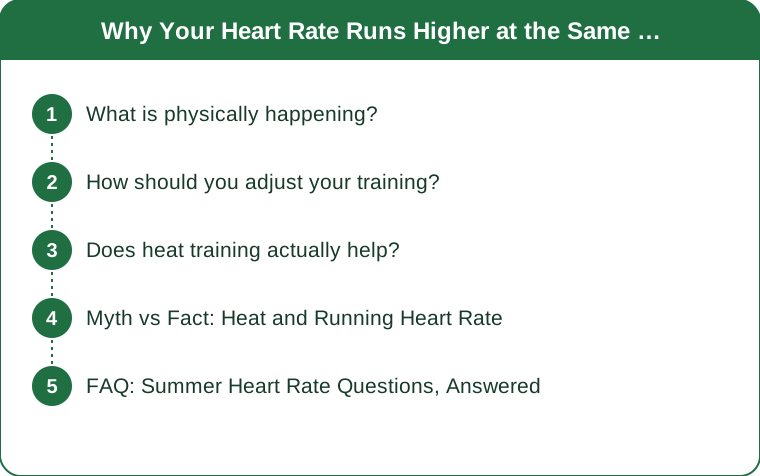
What is physically happening?
Your circulatory system is doing two jobs at once with the same volume of blood.
During exercise in cool conditions, most blood flow goes to working muscle. In heat, a substantial share is diverted to the skin, where it releases heat to the environment. Both demands are competing for the same finite blood volume.
Blood pooled in the dilated vessels near the skin is not returning promptly to the heart. That reduces venous return, which reduces the volume the heart can eject with each beat - stroke volume falls.
Cardiac output is heart rate multiplied by stroke volume. If stroke volume drops and the same output is needed, heart rate has to rise to compensate. That is the whole mechanism, and it is straightforward arithmetic.
Dehydration compounds it directly. Sweat is drawn from plasma, so fluid loss reduces blood volume itself. A 2% loss of body weight in fluid can raise heart rate meaningfully and reduces stroke volume further.
Cardiac drift is the version you see within a single run. Heart rate climbs progressively at an unchanged pace, typically becoming noticeable after 20 to 30 minutes and continuing throughout. In heat it starts sooner and rises faster.
Typical magnitudes:
- 5 to 10 beats per minute higher in moderate heat at the same pace
- 10 to 20 beats in significant heat and humidity
- A further 5 to 15 beats of drift over a long run, on top of that
Humidity is the multiplier people underestimate. Sweat only cools you when it evaporates. In high humidity the air is already close to saturated, evaporation slows dramatically, and sweat runs off without removing heat. A 25 degree day at 85% humidity is physiologically harder than a 30 degree day at 30%.
How should you adjust your training?
Run by effort or heart rate, not by pace, and adjust the pace expectation rather than pushing through.
The core principle: the purpose of an easy run is a physiological stimulus, not a pace. If your easy heart rate zone now corresponds to a pace 30 seconds per kilometre slower, run that pace. Holding the old pace turns an easy run into a moderate one, which accumulates fatigue without the intended benefit.
Rough pace adjustments for heat, which are approximate and vary by individual:
- Around 15 to 20 degrees: minimal adjustment for most people
- 20 to 25 degrees: roughly 2 to 5% slower
- 25 to 30 degrees: roughly 5 to 8% slower
- Above 30 degrees, or high humidity at any temperature: 8 to 12% slower or more
On a 5:30/km easy pace, 8% is about 26 seconds per kilometre. That is a large-looking adjustment and it is the correct one.
Practical training changes:
- Move hard sessions to early morning, which is both cooler and lower humidity in most climates
- Keep long runs by time rather than distance when it is very hot
- Do quality sessions on a treadmill if outdoor conditions would compromise them badly - this is not cheating
- Take more recovery between intervals, since heat impairs the recovery itself
- Reduce weekly volume slightly during a heatwave rather than grinding through
Hydration, done properly:
- Start hydrated - checking urine colour before a run is a crude and reliable measure
- 400 to 800ml per hour during running in heat, adjusted for your sweat rate
- Electrolytes for anything over an hour, since sodium loss is substantial and water alone can leave you feeling worse
- Weigh yourself before and after a long run to learn your actual sweat rate - it varies enormously between people
And record conditions in your training log. A run at 5:45/km at 29 degrees is a better run than 5:30/km at 14 degrees, and a log that does not show that will read as a decline when you were actually improving.

Does heat training actually help?
Yes, meaningfully - acclimatisation is real and it happens faster than most adaptations.
Repeated exposure to exercise in heat produces measurable physiological changes over 10 to 14 days:
- Plasma volume expands by 4 to 15%, which restores stroke volume and directly lowers heart rate at a given pace
- You start sweating earlier and at a lower core temperature, cooling more effectively
- Sweat rate increases, and sweat becomes more dilute as the body conserves sodium
- Skin blood flow becomes more efficient, so less cardiac output is diverted for the same cooling
- Perceived exertion falls at the same workload
Most of the adaptation occurs in the first week, with refinement over the second. It also decays relatively quickly - within one to two weeks of no heat exposure.
The plasma volume expansion is genuinely useful beyond hot weather. A larger blood volume improves stroke volume in any conditions, which is why some athletes use heat training deliberately as a performance intervention.
How to acclimatise sensibly:
- Progressive exposure over 10 to 14 days, starting with short easy sessions in the heat
- Build duration before intensity
- Do not attempt hard sessions in the heat during the first week
- Hydrate properly throughout - acclimatisation is not achieved by training dehydrated
For an autumn race, the timing works in your favour. Summer training builds the adaptation, and cool race day conditions will feel dramatically easier - a common experience for anyone who has trained through a hot summer for an October half marathon.
And the safety limits, which matter more than the training benefit. Stop immediately for: dizziness, confusion, nausea, headache, chills or goosebumps in heat, or stopping sweating while still hot. Those are heat illness signs and they escalate quickly. Get to shade, cool down actively, take fluids, and seek medical help for anything beyond mild. No training session is worth pushing through those.
Myth vs Fact: Heat and Running Heart Rate
Myth: A higher heart rate at the same pace means you have lost fitness. Fact: It means blood flow is being shared between working muscle and skin cooling, reducing stroke volume so the heart beats more often for the same output. It is a conditions effect and it reverses when the weather does.
Myth: You should push through and hold your normal paces. Fact: That converts an easy run into a moderate one, accumulating fatigue without the intended adaptation. The physiological stimulus is what matters, and running by effort delivers it at whatever pace the day allows.
Myth: Temperature is what matters. Fact: Humidity is often the bigger factor. Sweat only cools you when it evaporates, and in saturated air it runs off without removing heat. Twenty-five degrees at 85% humidity is harder than thirty at 30%.
Myth: Heat training is just suffering with no benefit. Fact: Acclimatisation expands plasma volume by 4 to 15% and improves sweating efficiency within 10 to 14 days, and the larger blood volume helps in cool conditions too. Summer training for an autumn race is genuinely advantageous.
Myth: Drinking more water is enough. Fact: Sodium loss through sweat is substantial, and replacing only water can leave you feeling worse rather than better. Anything over an hour in heat wants electrolytes alongside the fluid.
Myth: Feeling chilled in heat means you are cooling down well. Fact: Chills, goosebumps or stopping sweating while still hot are heat illness warning signs. They mean stop, cool actively and seek help - not that the run is going well.
FAQ: Summer Heart Rate Questions, Answered
How much higher should my heart rate be?
Roughly 5 to 10 beats per minute at the same pace in moderate heat, and 10 to 20 in significant heat and humidity, plus a further 5 to 15 of drift over a long run. Substantially more than that with no other explanation is worth paying attention to.
Should I slow down or push through?
Slow down. Easy runs exist for a physiological stimulus, not for a pace, and holding your cool-weather pace turns them into moderate efforts that accumulate fatigue. Run by effort or heart rate and let the pace be what it is.
How much slower is normal?
Around 2 to 5% slower at 20 to 25 degrees, 5 to 8% at 25 to 30, and 8 to 12% or more above 30 or in high humidity. On a 5:30 per kilometre pace, 8% is about 26 seconds - a large adjustment and the correct one.
How long does acclimatisation take?
Ten to fourteen days of progressive exposure, with most of the adaptation in the first week. Plasma volume expands 4 to 15%, sweating starts earlier and works better, and perceived effort drops. It decays within one to two weeks without heat exposure.
Why is humidity worse than heat?
Sweat cools you by evaporating, and in nearly saturated air it cannot evaporate efficiently, so it runs off without removing heat. This is why a moderately warm humid day can be physiologically harder than a hotter dry one.
When should I stop a run?
Dizziness, confusion, nausea, headache, chills or goosebumps while hot, or stopping sweating while still hot. Those are heat illness signs, they escalate quickly, and they need active cooling and medical help rather than finishing the session.
TL;DR:
- In heat, blood is shared between working muscle and skin cooling, cutting stroke volume
- Heart rate rises to maintain cardiac output - the number is accurate, not a malfunction
- Expect 5 to 10 beats higher in moderate heat, 10 to 20 in severe, plus drift over a long run
- Humidity matters more than temperature, because sweat only cools when it evaporates
- Run by effort or heart rate; expect 5 to 12% slower paces and log the conditions
- 400 to 800ml per hour with electrolytes for anything over an hour
- Acclimatisation takes 10 to 14 days and expands plasma volume 4 to 15% - it helps in cool weather too
Stop for dizziness, confusion, chills or stopping sweating. Nothing in a training block is worth that.
Keep Reading
This article is for general informational purposes only and is not medical advice. Always consult a qualified health professional for guidance specific to you.