What a Mid-Training Cold Actually Costs Your Half Marathon Plan
Quick Answer: A week off with a common cold costs very little. Aerobic fitness declines measurably only after about 10 to 14 days of complete inactivity, and a 7-day break in the middle of a 12-week plan typically costs less than 2% of VO2max - often nothing you can detect on race day. What actually wrecks races is the return: cramming missed mileage, skipping the rebuild, and turning a 7-day illness into a 3-week injury. Use the neck check, take the days, and return at about 70% for the first three runs.
The race is not lost in the week you were sick. It is lost in the ten days afterwards.

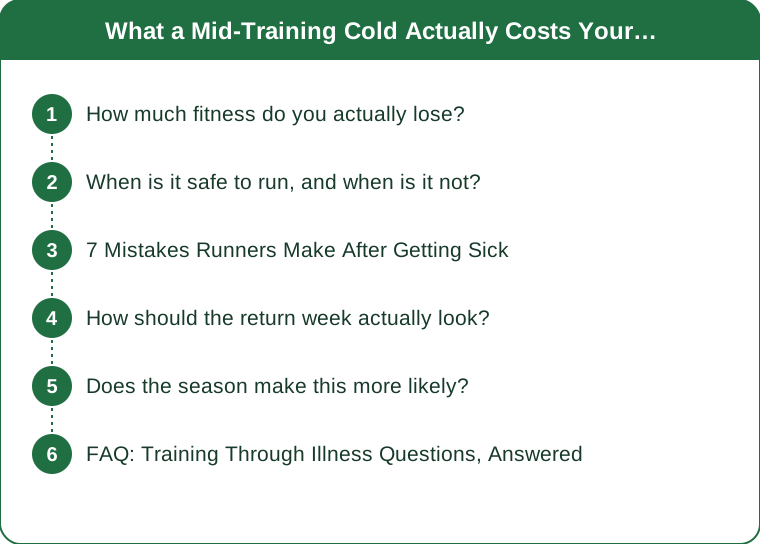
How much fitness do you actually lose?
Far less than the anxiety suggests, and the numbers are reassuring.
Nothing meaningful in the first week. Studies of trained runners show VO2max holding essentially steady for roughly the first 7 to 10 days of inactivity. Some early decline in blood plasma volume occurs within days, but it rebounds quickly once you resume.
Detraining becomes measurable at 2 to 4 weeks. Expect roughly a 4 to 6% VO2max decline over three weeks off, with muscular endurance and running economy declining somewhat faster than raw aerobic capacity.
Fitness built over months does not vanish in days. The adaptations from eight weeks of training - mitochondrial density, capillary networks, tendon adaptation - are structural and durable.
Missing one long run is not a crisis. In a 12-week half marathon plan, the aerobic base is built by the cumulative volume rather than one session. Missing your 10-miler in week 7 does not remove your ability to run 13.1.
And illness itself matters more than the missed miles. Training through a fever or a chest infection can prolong illness significantly and, rarely, cause serious complications. The downside of resting is measured in percentage points; the downside of pushing through is measured in weeks.
When is it safe to run, and when is it not?
The neck check is the standard, and it is genuinely useful.
Symptoms above the neck - runny nose, sneezing, mild sore throat, minor congestion - generally mean easy running is acceptable if you feel up to it. Reduce intensity and duration; treat it as an easy day regardless of what the plan says.
Symptoms below the neck - chest congestion, a productive cough, body aches, fever, stomach upset - mean do not run. Fever in particular is a hard stop. Exercising with a fever raises core temperature further, worsens dehydration, and is associated with rare but serious cardiac complications.
Fatigue is a symptom too. A cold that leaves you exhausted is a cold your body is spending significant resources on. Adding a training load competes for those resources directly.
Resting heart rate is a useful objective check. An elevated morning resting heart rate - roughly 7 or more beats above your normal - suggests your body is still working hard on recovery, and is a good reason to wait another day.
And the day you feel better is not the day you are recovered. Feeling normal at rest happens before your system tolerates load normally. Give it 24 hours past symptom-free before the first real run - that single day of patience prevents most relapses.
7 Mistakes Runners Make After Getting Sick
1. Trying to make up missed mileage. The most common and most costly. Missed miles are gone; adding them to the following week produces a sudden volume spike into a body that is still recovering, which is exactly how injuries happen. Never make up more than one missed session.
2. Going straight back to the plan’s prescribed intensity. The plan assumed a healthy week beforehand. Your first three runs back should be easy regardless of what is written for that day.
3. Testing fitness immediately. The urge to check whether you have lost anything is strong and the timing could not be worse. You will run slower than usual for a few days regardless, and reading that as lost fitness leads people to panic-train.
4. Ignoring how much hydration status changed. Fever, sweating, and reduced drinking during illness leave you meaningfully dehydrated. Dehydration raises heart rate and perceived effort, which is why the first run back feels so much harder than it should.
5. Skipping the long run rebuild. Coming back to the full-distance long run immediately is the highest-risk single decision. Cut the first long run back by about 30% and return to normal the following week.
6. Panicking about the race and changing the whole plan. Rewriting a training plan from a position of anxiety produces worse plans. The original plan with one week removed is almost always better than an improvised replacement.
7. Not adjusting the goal honestly if the illness was serious. A week with a head cold changes nothing. Two weeks with a chest infection three weeks out from race day is a genuine reason to reconsider the target - and running the race at an easier effort is a real option rather than a failure.

How should the return week actually look?
Three easy runs, then rejoin the plan.
Run 1 (day one back): 20 to 30 minutes, very easy. Conversational to the point of feeling too slow. The goal is to confirm your body tolerates load, not to train. If you feel worse afterward or the next morning, take another day.
Run 2: 30 to 40 minutes easy. Same effort, slightly longer. Check your morning resting heart rate before you go; if it is still elevated, repeat run 1 instead.
Run 3: a normal easy run at normal duration. By this point most people feel roughly themselves again.
Then rejoin the plan where it currently is - not where you left off. The plan is a schedule, not a checklist to complete. Trying to run the weeks you missed is the mistake that turns a lost week into a lost month.
Add intensity back last. Easy running first, then a shorter long run, then intervals or tempo work. Speed sessions place the most stress on tissues that have been idle, and they are the most common trigger for post-illness injuries.
Sleep and eat like it is part of training. Recovery from illness competes for the same resources as training adaptation. An extra hour of sleep for a week does more for your race than any session you might squeeze in.
Does the season make this more likely?
Yes - and half marathon training in the late-summer-into-autumn window collides with it directly.
Cold season starts as schools return. Late August and September bring a reliable spike in circulating viruses, right when 12-week plans for October and November races are hitting peak volume.
Heavy training suppresses immunity temporarily. The window after a very hard or very long session is associated with increased susceptibility. This does not mean training makes you sick, but the combination of peak weeks and peak virus circulation is real.
Temperature swings mean the wrong kit gets worn. Standing around in a sweat-soaked top after an early autumn long run, when the air is 12 degrees rather than 25, gets you chilled and miserable - and while cold air does not cause colds, being cold and wet does not help recovery.
Practical adjustments for this stretch: change immediately after long runs, get a hot drink and food within 30 minutes, wash your hands after gyms and public transport, and keep sleep genuinely prioritized during peak weeks.
And build a buffer into the plan. A 12-week plan with two flexible weeks built in absorbs an illness without drama. Assume you will lose a week somewhere - most runners do, and the ones who plan for it arrive at the start line unbothered.
FAQ: Training Through Illness Questions, Answered
Can I run with a head cold?
Generally yes if symptoms are above the neck and you feel up to it - at easy effort and reduced duration. Skip it entirely if you have a fever, chest symptoms, or body aches.
How long before a race is illness a real problem?
A cold in the final week means an easier race but rarely a missed one; run it at a lower target effort. A fever or chest infection within a week of the race is a strong reason not to start, and a race is not worth a cardiac risk.
Will one missed long run ruin my race?
No. A single missed long run in a plan with several others changes very little. Missing three or more in a row is a different conversation and may warrant adjusting the goal.
Should I take antibiotics to get back faster?
Antibiotics do nothing for viral infections, which is what most colds are, and taking them unnecessarily carries its own risks. That decision belongs to a doctor, not a training plan.
This is general information, not medical advice. Fever, chest symptoms, or illness that is not improving should be assessed by a healthcare professional.
TL;DR:
- A week off costs almost nothing - meaningful detraining starts around 10 to 14 days.
- Use the neck check: above-the-neck symptoms allow easy running, below-the-neck symptoms and any fever mean rest.
- Return with three easy runs at about 70%, cut the first long run by 30%, and rejoin the plan where it is rather than where you left it.
- Never make up missed mileage; add intensity back last.
The honest framing is that illness costs almost nothing and impatience costs a lot. If you are training through the back-to-school virus season for an autumn race, build a flexible week into the plan now - you will probably need it, and having planned for it is the difference between a shrug and a spiral.
Keep Reading
This article is for general informational purposes only and is not medical advice. Always consult a qualified health professional for guidance specific to you.