After the Half: The Recovery Week and the What-Now Question
The half-marathon finish line answers one question and asks another — first the legs need their week, then the what-now menu opens: faster, farther, or the third option nobody markets. The after-guide: the recovery protocol, the return-to-running and the honest next-goal menu.

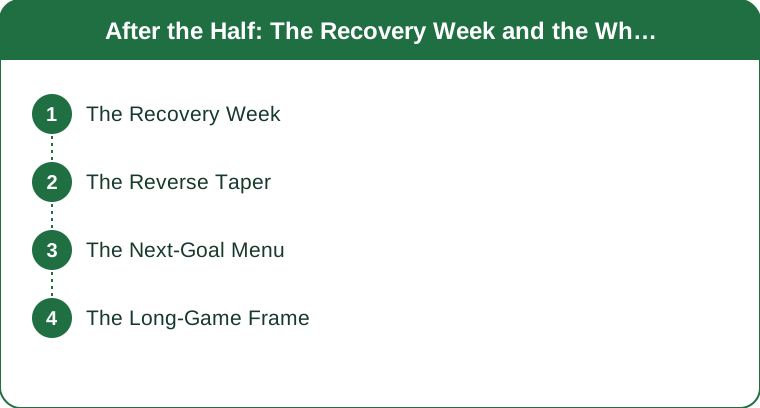
The Recovery Week
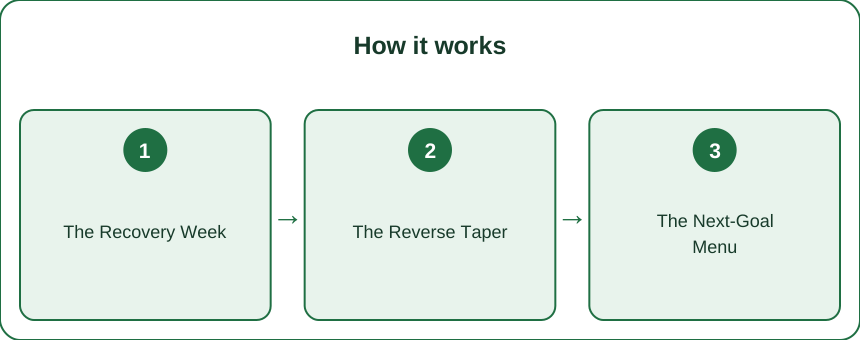
The days after 13.1: the first 48 hours (walking as therapy — the gentle motion that beats couch-lock; the stairs-descended-backwards comedy is normal DOMS at race scale; the protein-sleep-hydration recovery basics at full deployment), the no-running window (most plans prescribe 3-7 running-free days — the tissues that carried the race deserve the week; the pool, bike and walk tier keeping movement alive per the active-recovery chapter), the sleep-and-appetite waves (the post-race days of extra hunger and heavy sleep — the body invoicing; pay it), the immune-window note (the days after max efforts run slightly immune-suppressed — the hygiene-and-rest awareness that keeps the race’s cold away), and the celebration clause (the medal photographed, the race recounted, the achievement actually absorbed — the recovery week’s psychological half; you did the thing).
The Reverse Taper
Returning to running: the week-two structure (short easy runs — the 20-30 minute conversational returns; the pace-ego parked; the legs report and you listen), the week-three normalization (the regular easy week resuming — volume near normal, intensity still waiting), the week-four green light (the full training menu returns for the recovered — the tempo and interval work back on the calendar), the individual honesty (recovery timelines vary by race effort and training age — the raced-it-hard first-timer needs the full month; the comfortable finisher bounces sooner; the lingering-fatigue signals extend the timeline without shame), and the injury-check window (the niggles masked by race adrenaline surface in the recovery weeks — the two-week-old ache gets attention now, cheap, rather than in month three, expensive).

The Next-Goal Menu
The what-now options, honestly: the faster path (the same distance, trained for time — the tempo-and-interval emphasis the finish-goal plan skipped; the second half is where most runners find surprising minutes; the shorter-race detour — the fast 10K block — that makes the next half quicker), the farther question (the marathon conversation — the honest prerequisites: the half felt manageable, the training time doubles-ish, and the WANT is yours, not the finish-line adrenaline’s; the marathon deferred a season is a marathon run better), the sideways options (the trail-half, the relay, the race-cation — the same distance in new costumes; the variety that keeps year three interesting), and the third option (the no-goal running life — the maintenance miles, three runs weekly, no start lines; a complete and honorable running identity that the race-industrial complex undersells; the runner who just… runs, forever, won the actual game).
The Long-Game Frame
Whatever comes next: the base-banking truth (the half’s training built an aerobic base that compounds — the next goal starts from higher ground; fitness is a savings account and the race was a deposit, not a withdrawal), the annual-rhythm suggestion (one-to-two goal races yearly with training seasons between — the periodization that keeps decades of running; the always-racing calendar is the burnout schedule), the community carry-forward (the training-group and race-day connections that outlast the goal — the friendship-through-fitness dividend collecting), and the identity note (the finish line’s real product was ‘someone who trains for things’ — the identity that transfers to every next goal, running or otherwise; the medal is the receipt, the habit is the prize). Recover fully, choose freely: the finish line was a door.
Walk the first week, reverse-taper the return, choose faster-farther-or-neither honestly. The half’s finish line opens a menu — and the no-goal running life is on it, fully legal.
Keep Reading
This article is for general informational purposes only and is not medical advice. Always consult a qualified health professional for guidance specific to you.