How to Set a Realistic Half Marathon Goal Time
Quick Answer: The most reliable predictor is a recent race at a shorter distance, converted with a standard calculator, then adjusted for how much long-run volume you have actually done. A 10K time predicts a half well if your endurance base supports it - and that caveat is where most people overreach.
Set three goals rather than one: an A goal for a good day, a B goal you are confident of, and a C goal that counts as a successful race regardless.

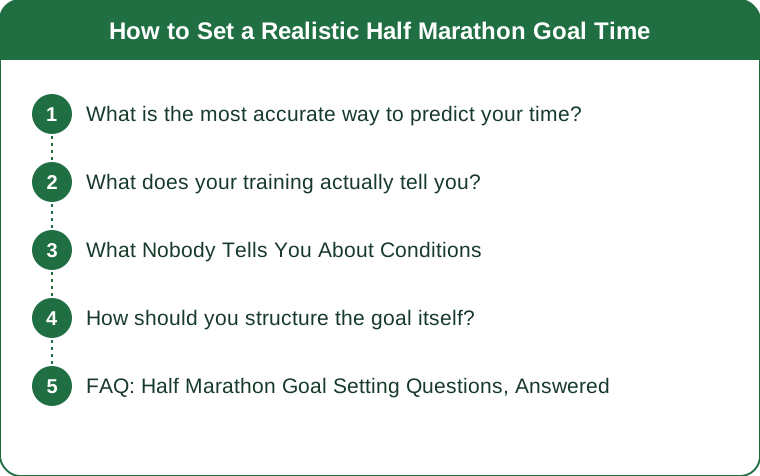
What is the most accurate way to predict your time?
A recent race result at a shorter distance, converted, then reality-checked against your training.
Race equivalency calculators use the well-established relationship between performance across distances. The most common approach is based on the observation that pace slows by a fairly predictable factor as distance doubles - roughly, a good rule of thumb is that your half marathon pace is somewhat slower than your 10K pace, and your 10K somewhat slower than your 5K.
What makes a prediction reliable:
- A recent race, within the last six weeks or so. Fitness moves.
- A genuine all-out effort, not a training run or a parkrun you jogged. A conservative effort predicts a conservative half.
- A comparable course. A flat 10K predicts a flat half; a hilly time predicts differently.
- The right distance. A 10K is the best single predictor for a half. A 5K works but over-predicts for people with limited endurance, because it rewards speed over the durability the half demands.
The critical caveat: these conversions assume adequate endurance training for the longer distance. A runner with a fast 10K who has never run beyond eight miles will not hit the predicted half time, because the prediction assumes a base they do not have.
The correction that makes this work in practice:
- If your longest run is 10 miles or more and you have done several, take the prediction at close to face value
- If your longest run is 8 to 10 miles, add a couple of minutes to the prediction
- If your longest run is under 8 miles, the prediction is not usable - finishing well is the goal, and that is a perfectly good goal
No recent race? A hard tempo effort of 4 to 6 miles, or a well-executed long run with the last few miles at effort, gives you a usable estimate - less precise, but far better than a number you like the sound of.
What does your training actually tell you?
More than any calculator, because it reflects what you have done rather than what you might be capable of.
Three specific sessions predict race day well:
The long run with a strong finish. A long run of 10 to 12 miles where the last 3 are at your target race pace and feel controlled is the single most informative session. If those miles feel sustainable, the pace is realistic. If they feel like a maximum effort, race day will be harder over a longer distance - the pace is too fast.
A tempo run of 4 to 6 miles. Half marathon pace should be somewhat slower than tempo pace for most trained runners. If you can hold a 5-mile tempo comfortably at a given pace, your half pace is likely a bit slower than that.
Total weekly volume. This is the honest constraint. General guidance for running a half marathon well tends to point toward consistent weekly mileage well above the race distance, sustained over months. Someone running 15 miles a week is capable of finishing a half and should set a finishing goal; someone running 35 miles a week has earned a time goal.
What to be skeptical of:
- A single great workout. One good session on a cool day with fresh legs is not a fitness level. Look at the pattern.
- Watch race predictors. They vary in quality and generally overestimate, particularly for runners whose training skews short and fast. Treat them as one input.
- Last year’s time. Fitness is not stored. What you did twelve months ago tells you about your ceiling, not your current form.
The most common overreach is setting a goal based on what you should be able to do given your speed, while ignoring the endurance side. The half marathon punishes that specifically - the wheels come off in the last three miles, which is exactly where endurance rather than speed decides the outcome.

What Nobody Tells You About Conditions
A goal time is only valid for a specific set of conditions, and most people set the number months ahead and never revisit it.
Temperature is the biggest external variable. Performance in endurance running degrades measurably as temperature rises above a fairly cool optimum - and the effect is larger over longer distances and for runners spending more time on the course. A goal set during cool spring training may simply not be available on a warm race day, and this is not a failure of effort or resolve.
The relevant seasonal point right now: if you have trained through late summer heat for an autumn race, you are probably fitter than your training paces suggest. Heat slows training paces substantially, so runners who trained through August frequently arrive at an October race believing they are slower than they are. This is one of the few pleasant surprises in the sport, and it is a genuine argument for setting an ambitious A goal for an autumn race.
The other conditions worth adjusting for:
- Humidity, which impairs cooling and matters as much as raw temperature
- Wind, where a headwind costs more than a tailwind gives back
- Course profile. Net elevation matters, but so does where the hills are - a hill at mile 11 costs far more than the same hill at mile 2
- Altitude, if racing meaningfully higher than you train
How to handle it: set your goal, then decide on race morning. Look at the forecast the night before and adjust. Adding time to a goal because it is 75 degrees and humid is not lowering your standards; it is reading the conditions correctly. Runners who refuse to adjust for heat are the ones walking at mile 10.
One more variable people ignore entirely: sleep in the week before. Race-night sleep matters less than most people fear, but the two or three nights before that matter quite a lot, and they are more controllable than the weather.
How should you structure the goal itself?
Three goals, not one. It is a small change that transforms how the race feels.
The A goal - what is possible on a good day with good conditions and everything going right. Ambitious but not fantasy. Perhaps 2 to 3 percent faster than your realistic prediction.
The B goal - what you are confident of if the day is ordinary. Your honest prediction. This is the number you actually pace by for the first half of the race.
The C goal - what counts as a good race even if things go wrong. Often this is not a time at all: finish strong, negative split, do not walk, enjoy it. A C goal is the difference between a hard day being a disappointment and a hard day being a race you learned from.
Why three works: a single goal makes the race binary, and a binary race that is going badly at mile 8 gives you no reason to keep executing well. With three, there is always something left to run for, and runners who have something to run for finish faster.
How to actually race it:
- Start at B goal pace, or slightly slower. The most common and most costly mistake in the half is going out at A goal pace. Two seconds per mile too fast for the first six miles is recoverable; fifteen is not.
- Reassess at the 10K mark. If B pace feels genuinely easy and conditions are good, move toward A pace in the second half. This is how a negative split happens, and negative splits produce the fastest times for most amateur runners.
- Reassess again at mile 9 or 10. This is where the race actually begins. If you are struggling, shift to the C goal and execute it well rather than blowing up chasing B.
- Do the arithmetic before the race. Know your target splits for each mile, or at least for 5K, 10K, and 10 miles. Doing mental maths at mile 11 is not realistic.
And set the goals about two to three weeks out, once the hard training is done and you know what you have. Setting a goal at the start of a training block is guessing about a person who does not exist yet.
FAQ: Half Marathon Goal Setting Questions, Answered
Is it better to aim high and fall short, or set something safe?
For most runners, an honest B goal with an ambitious A goal above it beats either extreme. A goal that is too aggressive causes a blow-up, and blow-ups are worse than slow times - they are painful, they take longer to recover from, and they make the next race harder mentally. A goal that is too soft costs you very little except a slightly slower time.
How much does a first half marathon differ?
Quite a lot, and the honest advice for a first one is to set a finishing goal rather than a time goal. You have no data on how your body handles the distance, how your fueling works at mile 10, or how race adrenaline affects your pacing. Finish it, learn what happens, then set a time goal for the next one with real information.
Should I adjust my goal if training went badly?
Yes, and adjusting is the correct response rather than a concession. A block with missed weeks, illness, or injury produces less fitness than a complete one. Racing an out-of-date goal on undertrained legs is how people get hurt. Reset it and race well against the new number.
How much faster can I realistically get between races?
Varies enormously with experience. Newer runners often improve substantially between their first and second half, because they are gaining fitness and learning to race simultaneously. Experienced runners near their ceiling may gain very little over a whole year. Improvement slows as you get closer to your potential, which is normal rather than a plateau to fix.
TL;DR:
- A recent all-out 10K converted with a race calculator is the best single predictor - then adjust for how much long-run volume you have actually done.
- A 10 to 12 mile long run finishing at target pace is the most informative session you can run; if it feels maximal, the pace is too fast.
- Heat degrades endurance performance measurably, so decide the final number on race morning with the forecast in hand.
- If you trained through late summer heat for an autumn race, you are probably fitter than your training paces suggest.
- Set three goals - ambitious, confident, and a good-race-regardless - and pace the first half by the middle one.
Set your numbers two to three weeks out, once the hard training is done. Before that, you are guessing about someone who does not exist yet.
Keep Reading
This article is for general informational purposes only and is not medical advice. Always consult a qualified health professional for guidance specific to you.