Half Marathon Training Through the First Cold Weeks
Quick Answer: Cooler air genuinely makes you faster - most runners see 10 to 20 seconds per kilometre improvement at the same effort once temperatures drop from 25C to 12C, because your body is no longer diverting blood to cooling. The trap is treating that as a fitness jump and racing your easy runs. Run by effort or heart rate through the transition, not by the paces you were hitting in August.
The other change nobody plans for: your fuelling and hydration needs shift, and thirst becomes an unreliable signal.

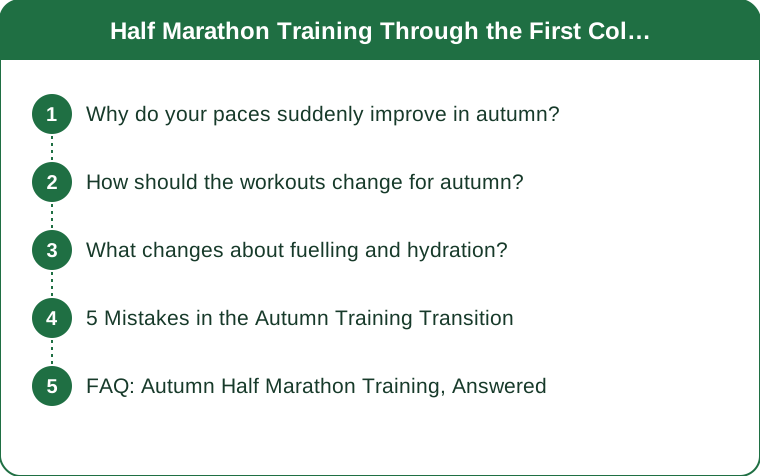
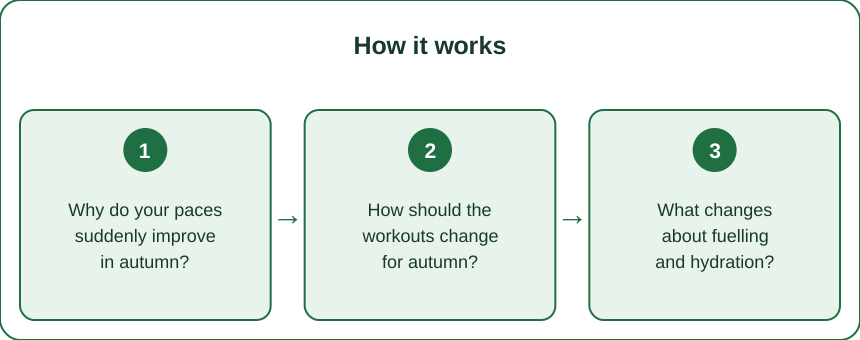
Why do your paces suddenly improve in autumn?
Because a large physiological tax gets removed all at once.
What heat costs you. In hot conditions, your body diverts blood to the skin for cooling, which reduces the blood available to working muscle. Heart rate rises at any given pace - a phenomenon called cardiac drift - and performance degrades progressively above roughly 15C.
The scale of the effect. Research on marathon performance consistently shows optimal conditions somewhere around 10 to 12C for most runners, with performance falling measurably as temperatures rise from there. Going from 25C to 12C removes a substantial handicap.
What runners typically experience:
- 10 to 20 seconds per kilometre faster at the same heart rate
- Easy runs that feel easy again, after a summer of them feeling anything but
- Lower heart rate at any given pace, often by 5 to 10 beats
- Better performance in the second half of long runs, since heat accumulation is no longer the limiter
The trap this creates. It feels like a sudden fitness jump, and the natural response is to start running your easy runs at the new faster pace.
- The pace improved because conditions improved, not because your aerobic system changed
- Running easy runs harder shifts them out of the easy zone entirely
- Which compromises recovery and undermines the hard sessions that actually drive adaptation
- This is one of the most common autumn training errors and it typically shows up as fatigue three weeks later
The correct response. Run easy runs by effort or heart rate, not by pace. If your easy pace is now faster at the same heart rate, excellent - take the free speed. But the effort must stay easy. The classic mistake is treating a conditions-driven pace as a new baseline and then wondering why the quality sessions start suffering.
How should the workouts change for autumn?
This is the window to do the specific work that heat made impossible.
What becomes possible in cooler air:
- Threshold and tempo running, which is heavily degraded by heat. This is the highest-value session for half marathon performance and it works properly now
- Long runs at goal pace, which were unrealistic in summer
- Interval sessions with quality maintained to the last rep
- Back-to-back quality days, since recovery is better in cool conditions
A sensible autumn week for a half marathon build:
- One threshold session. Something like 3 x 10 minutes at threshold with 2 minutes recovery, or 20 to 30 minutes continuous
- One long run, building toward 16 to 20km, with the last 20 to 25 percent at goal pace in the later weeks
- Two to three easy runs, genuinely easy
- Optional short intervals for a bit of speed - 8 to 10 x 400m
Progression rules that still apply:
- Increase weekly volume by no more than about 10 percent, and the cooler weather makes it tempting to exceed this
- Every fourth week reduce volume by 20 to 30 percent
- Do not increase volume and intensity in the same week
- The cooler weather makes overreaching easier, because the natural brake heat provided is gone
Race-specific preparation:
- Train at the time of day your race starts, since morning conditions differ substantially from afternoon
- Practise in the clothing you will race in, which is a bigger question in autumn than summer
- Rehearse your fuelling in the long runs at goal pace
- Run some of it on the race terrain if the race is local
On the surface change nobody plans for. Wet leaves are genuinely slippery, particularly on painted lines, wooden bridges, and tree roots. Autumn is a common season for ankle injuries for this reason. Shorten your stride slightly on leaf-covered paths and be cautious on descents.

What changes about fuelling and hydration?
Both, and the changes go in opposite directions from what people assume.
Hydration, where thirst stops being reliable:
- Sweat rate falls in cool weather, but not as much as most people think - you still lose significant fluid on a long run at 10C
- Thirst perception drops considerably in cold air, so the signal that guided you all summer stops working
- Respiratory water loss increases in cold dry air, which is invisible and unaccounted for
- Dehydration in cool weather is common precisely because nobody expects it
The practical approach:
- Weigh before and after a long run. Each kilogram lost is roughly a litre of fluid. This is the only accurate way to know your own rate in these conditions
- Drink to a schedule rather than to thirst on runs over 75 minutes
- Around 400 to 800ml per hour for most runners in cool conditions, adjusted by the weighing result
- Electrolytes still matter on longer efforts, though less than in summer heat
Fuelling, where the demand goes up:
- Carbohydrate use increases slightly in cold conditions, partly from thermoregulation
- Longer sessions become possible now that heat is not the limiter, which means more total fuel needed
- The 60 to 90g of carbohydrate per hour guidance for longer efforts still applies, and needs training - the gut adapts to carbohydrate intake with practice
- Practise race fuelling in cool weather specifically. What sat well in the heat may behave differently now, and gels are noticeably thicker and harder to swallow when cold
The warm-up, which needs genuine extension:
- 10 to 15 minutes of easy running before quality work, up from 5 to 10 in summer
- Dynamic drills after the easy portion, not before
- Progressive strides - 4 to 6 x 100m building to session pace
- Never start intervals cold. The first rep of a cold session is the highest injury risk moment of the week
Clothing rule of thumb. Dress for about 10C warmer than the actual temperature, because you will warm up substantially within 10 minutes. Being slightly cold at the start is correct. The most common autumn error is overdressing and then carrying a soaked layer for an hour.
5 Mistakes in the Autumn Training Transition
1. Treating the pace improvement as a fitness jump. Cooler air removes a physiological tax; it did not change your aerobic system. Run easy runs by effort or heart rate and enjoy the free speed without spending it.
2. Increasing volume and intensity at once because it feels easier. The heat was providing a natural brake and it is gone. Ten percent weekly volume increase still applies, and this is the most common route to an autumn injury.
3. Drinking to thirst. Thirst perception drops sharply in cool air while fluid loss remains significant, including invisible respiratory loss. Weigh before and after one long run and drink to a schedule after that.
4. Skipping the extended warm-up. In cool weather, quality sessions need 10 to 15 minutes of easy running plus drills and strides. The first interval of a cold session is the highest injury risk moment of your week, and it is entirely avoidable.
5. Overdressing. You warm up substantially within ten minutes. Dress for roughly 10C warmer than it is and accept being slightly cold at the start - carrying a soaked layer for the rest of an hour is worse than the first five minutes were.
The first two are the ones that end seasons. The other three just make individual runs worse.
FAQ: Autumn Half Marathon Training, Answered
How much faster should I be in cooler weather?
Most runners see 10 to 20 seconds per kilometre at the same heart rate going from 25C to around 12C. Optimal racing conditions are usually around 10 to 12C, so autumn genuinely is faster.
Should I update my training paces?
Update them based on a recent time trial or race in similar conditions, not on how your easy runs feel. And keep running easy runs by effort or heart rate regardless - the pace can improve as long as the effort stays easy.
Do I need to drink as much in cool weather?
More than you will feel like. Sweat rate falls but not as much as expected, thirst perception drops sharply, and respiratory water loss increases in cold dry air. Weigh before and after a long run to learn your actual rate.
How long should I warm up before a session in the cold?
Ten to fifteen minutes of easy running, then dynamic drills, then four to six progressive strides. Starting intervals cold is the highest injury risk moment in a training week.
How should I dress for autumn running?
For about 10C warmer than it actually is. You will be substantially warmer within ten minutes, and being slightly cold at the start is correct. Overdressing means carrying a soaked layer for the rest of the run.
Are wet leaves actually a hazard?
Yes, particularly on painted road markings, wooden bridges, and over tree roots. Autumn is a common season for ankle injuries. Shorten your stride slightly on leaf-covered surfaces and take descents more carefully.
TL;DR:
- Cooler air is worth 10 to 20 seconds per kilometre at the same heart rate - real, and not a fitness jump
- Run easy runs by effort or heart rate, or the free speed turns into three weeks of accumulated fatigue
- This is the window for threshold work and goal-pace long runs that heat made impossible
- Thirst becomes unreliable in cool air - weigh before and after a long run and drink to a schedule
- Warm up 10 to 15 minutes before quality work, and dress for about 10C warmer than it is
The cooler weather removes the brake that heat was providing all summer, which is exactly why the 10 percent rule matters more now than it did in July.
Keep Reading
This article is for general informational purposes only and is not medical advice. Always consult a qualified health professional for guidance specific to you.