Half Marathon Training and Your Menstrual Cycle: What Actually Changes Week to Week
Quick Answer: Many runners report feeling strongest during the follicular phase (right after your period through ovulation), when estrogen rises and tends to support better energy and recovery, while the luteal phase (after ovulation through the next period) often brings a slightly elevated resting heart rate, more perceived effort at the same pace, and greater fluid needs — these patterns vary significantly between individuals, so tracking your own cycle against training logs is more useful than assuming a universal pattern.

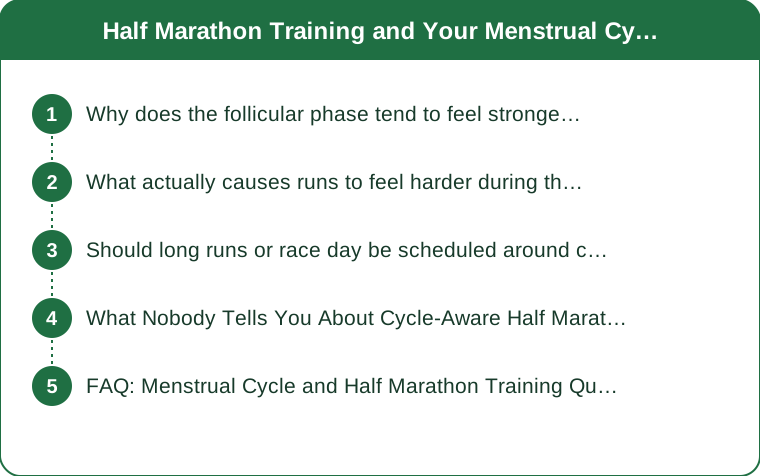
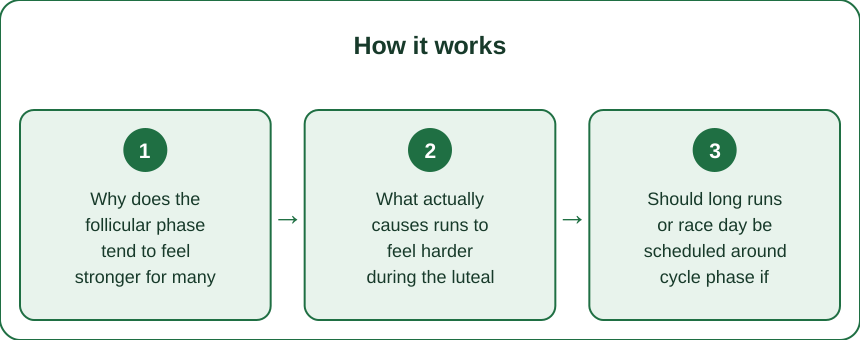
Why does the follicular phase tend to feel stronger for many runners?
Rising estrogen during the follicular phase is associated with improved glycogen storage and use, and many runners subjectively report better energy and quicker recovery during this window. This is part of why some training plans intentionally schedule harder speed or long-run sessions earlier in the cycle when possible, though individual response varies.
What actually causes runs to feel harder during the luteal phase?
Progesterone rises during the luteal phase, which is associated with a slightly elevated resting heart rate and body temperature, meaning the same pace can genuinely require a bit more cardiovascular effort than it would earlier in the cycle. This isn’t a fitness regression — it’s a measurable physiological shift, which is worth recognizing rather than interpreting as a bad training day.

Should long runs or race day be scheduled around cycle phase if possible?
When there’s flexibility (like choosing a goal race date months out), some runners do try to plan around avoiding the first couple days of their period for race day, though many run successfully at every cycle phase and race performance depends on far more than cycle timing alone. For scheduled training runs without flexibility, adjusting pace expectations rather than skipping is generally more useful than trying to reschedule around the cycle.
What Nobody Tells You About Cycle-Aware Half Marathon Training
Most generic training plans are built without any cycle awareness at all, which means a harder-than-expected week during the luteal phase can wrongly feel like a fitness plateau or a training mistake. Tracking cycle phase alongside pace, perceived effort, and sleep for even one full training cycle often reveals a pattern that reframes what actually felt like unexplained bad weeks.
FAQ: Menstrual Cycle and Half Marathon Training Questions, Answered
Is it safe to run a half marathon during your period?
Yes, for most runners without underlying conditions, running during your period is safe — some report feeling more comfortable with lighter tampon or cup use plus supportive activewear, but there’s no medical reason to avoid running.
Does hydration need actually change across the cycle?
Some research suggests slightly higher fluid needs during the luteal phase due to elevated body temperature, so being a bit more deliberate about hydration in the back half of the cycle is a reasonable, low-risk adjustment.
Should birth control method be considered when thinking about training cycle effects?
Hormonal birth control can flatten or change the typical cycle-related fluctuations described here, so runners on hormonal birth control may notice a different or less pronounced pattern than what’s typically described for a natural cycle.
TL;DR:
- The follicular phase often brings better energy and recovery for many runners
- The luteal phase commonly brings a higher resting heart rate and more perceived effort
- These are physiological shifts, not signs of a training mistake or fitness plateau
- Tracking cycle phase alongside training logs reveals patterns generic plans miss
Recognizing these patterns doesn’t mean training around them entirely — it means correctly interpreting a harder week as physiology, not failure.
Keep Reading
This article is for general informational purposes only and is not medical advice. Always consult a qualified health professional for guidance specific to you.