Why Your Half Marathon Falls Apart at Mile 9 — and How to Fix Your Splits
Quick Answer: Fading at mile 9-10 in a half marathon almost always traces back to running your first 5K 10-15 seconds per mile too fast on race adrenaline. Bank nothing early — run the first 3 miles at or slightly slower than goal pace, then let the back half be where you spend your effort.
You trained all the long runs. You did the tempo work. And yet every race, somewhere around mile 9, your legs just… stop cooperating. That’s not a fitness problem. It’s almost always a pacing problem, and it’s fixable with math you can do before the gun even goes off.

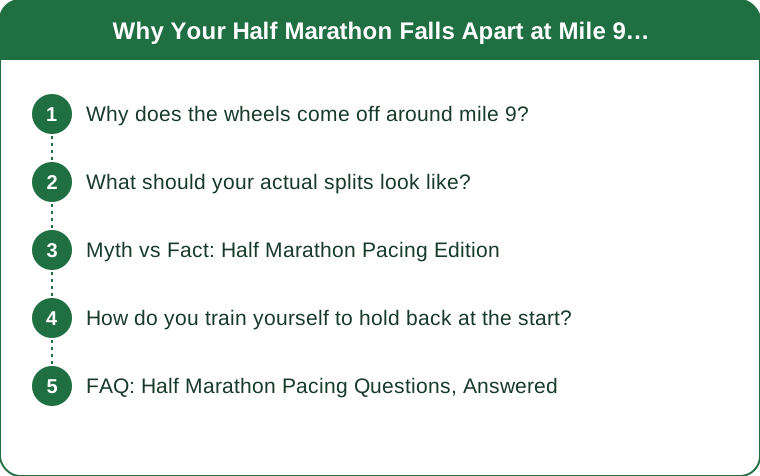
Why does the wheels come off around mile 9?
Because you spent glycogen you didn’t have to spend in miles 1-3. Race adrenaline plus a downhill start plus a fresh crowd of runners around you makes 10-15 seconds per mile too fast feel completely effortless early on.
That small overpay compounds. By mile 8 you’re running on fumes instead of fuel, and the body’s response isn’t graceful — it’s a hard, sudden fade, not a gentle slowdown.
What should your actual splits look like?
Aim for even or slightly negative splits: first half a touch slower than goal pace, second half a touch faster. For a 2:00 half (9:09/mile average), that might mean 9:15-9:20 for miles 1-3, settling to 9:09 by mile 6, and allowed to drop to 9:00 or faster after mile 10 if you have it.
Write your target mile-by-mile splits on your arm or set watch alerts. Racing without a number in front of you is how adrenaline wins.

Myth vs Fact: Half Marathon Pacing Edition
Myth: Banking time early gives you a cushion. Fact: There’s no cushion — there’s only debt you pay back with interest at mile 9, usually 2-3x whatever you ‘saved.’
Myth: If it feels easy in mile 2, you should go faster. Fact: Mile 2 is supposed to feel easy at goal pace. That’s what fresh legs and fresh fuel feel like. Easy-feeling is not the same as slow.
Myth: Fast starters are just fitter. Fact: Data from major half marathons shows even-paced finishers consistently outperform fast-starters of the same fitness level — the crash costs more than the early speed gains.
How do you train yourself to hold back at the start?
Practice negative splits in your last 2-3 long runs before race day: run the first half comfortably slow, the second half at goal pace. This builds the muscle memory (and the patience) to not chase the crowd off the start line.
Start behind your projected pace group by a few feet if you have to — being boxed in slightly at the start is a feature, not a bug, on race morning.
FAQ: Half Marathon Pacing Questions, Answered
Should I go out slower than goal pace on purpose?
Yes — 10-15 seconds per mile slower for the first 2-3 miles is a proven strategy, not a compromise. You get that time back and more after mile 10.
What if I feel great and want to speed up early?
Wait until mile 8 to make that call. Feeling great at mile 2 is expected; feeling great at mile 8 is information.
Does course elevation change this rule?
Downhill starts make this worse, not better — gravity adds free speed you don’t need to take. Hold your effort level, let the pace be whatever it is on the downhill.
TL;DR:
- The mile 9 crash starts in miles 1-3, not mile 9 itself
- Target even or slightly negative splits — slower first 3 miles, faster last 3
- Banking time early is debt, not a cushion — it costs more than it saves
- Practice negative splits in your last 2-3 long training runs before race day
Keep Reading
This article is for general informational purposes only and is not medical advice. Always consult a qualified health professional for guidance specific to you.