Should You Rotate Two Pairs of Shoes During Half Marathon Training?
Quick Answer: Rotating two pairs of shoes during training can reduce injury risk by varying the stress pattern on your feet and legs, and it extends the usable life of both pairs by giving cushioning foam time to recover between runs. It’s a worthwhile habit for most runners logging regular weekly mileage, not just an expensive nice-to-have.
Buying a second pair of running shoes when one already works fine feels unnecessary, until you look at what shoe rotation actually does during a training block.

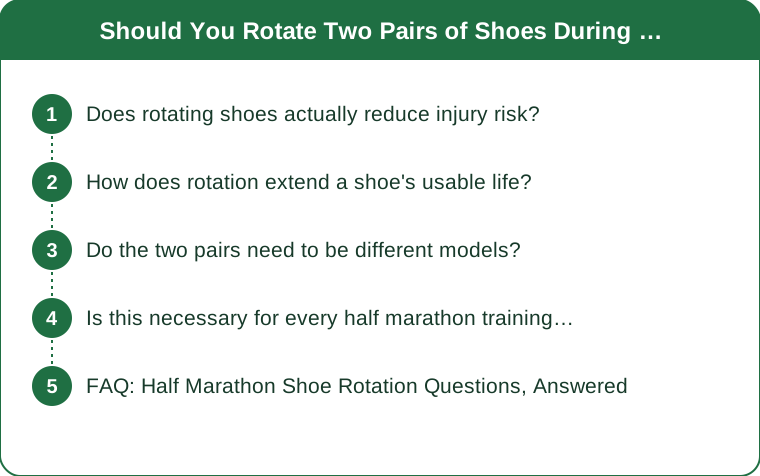
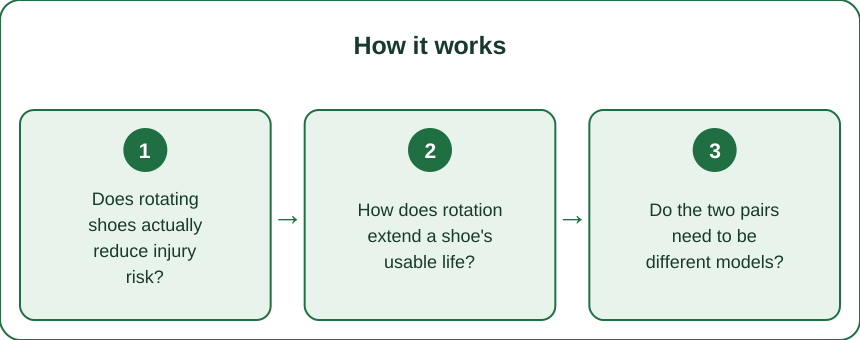
Does rotating shoes actually reduce injury risk?
Different shoe models — even slight variations in drop, cushioning, or stack height — distribute impact forces slightly differently across your feet and lower legs. Repeating the exact same stress pattern run after run in one shoe is thought to contribute to overuse injuries more than varying it slightly with a second pair.
How does rotation extend a shoe’s usable life?
Cushioning foam in running shoes needs roughly 24-48 hours to fully decompress and recover its bounce after a run. Running in the same pair daily means starting each run in partially uncompressed foam, while alternating lets each pair fully recover before its next use, which can meaningfully extend total mileage life.

Do the two pairs need to be different models?
Having two pairs of the exact same shoe still provides the recovery-time benefit, but pairing a daily trainer with a slightly different model (say, one with more cushioning for easy days and a lighter one for faster efforts) adds the stress-variation benefit as well. Two identical pairs is still better than one pair alone.
Is this necessary for every half marathon training plan, or just high-mileage ones?
Runners logging under 15-20 miles a week see a smaller benefit, since a single pair has more recovery time built in naturally between fewer runs. Once weekly mileage climbs past that range, rotation starts to matter more for both injury prevention and shoe longevity.
FAQ: Half Marathon Shoe Rotation Questions, Answered
How far into training should I introduce a second pair?
Ideally from the start of a training block, rather than only near race day, so your legs get used to both shoes well before the race and you’re not troubleshooting new shoe feel close to race day.
Should race day shoes be part of the rotation or kept separate?
Race day shoes should be broken in during training long runs, not worn for the first time on race day, so they function as part of the rotation rather than a completely separate pair.
Is it a waste of money if I’m not training for a specific time goal?
Even casual or first-time half marathon runners benefit from the injury-prevention side of rotation, so it’s not exclusively useful for performance-focused training.
TL;DR:
- Alternating shoes varies impact stress and may reduce overuse injury risk
- Foam cushioning needs 24-48 hours to fully recover between runs
- Two different models add stress variation on top of the recovery benefit
- Rotation matters more as weekly mileage increases past 15-20 miles
A second pair isn’t just a backup — it’s a legitimate training tool once mileage builds up.
Keep Reading
This article is for general informational purposes only and is not medical advice. Always consult a qualified health professional for guidance specific to you.