What Your Body Actually Needs the Week After a Half Marathon
Quick Answer: The first 2-3 days need complete rest or gentle walking only, followed by light cross-training by day 4-5, and no real running until day 7-10 — muscle micro-damage from 13.1 miles takes longer to fully repair than most runners expect.
The race is over, the medal’s around your neck, and the instinct is either to collapse for a week or jump straight back into training. Both extremes miss what the muscle tissue actually needs on a realistic timeline.

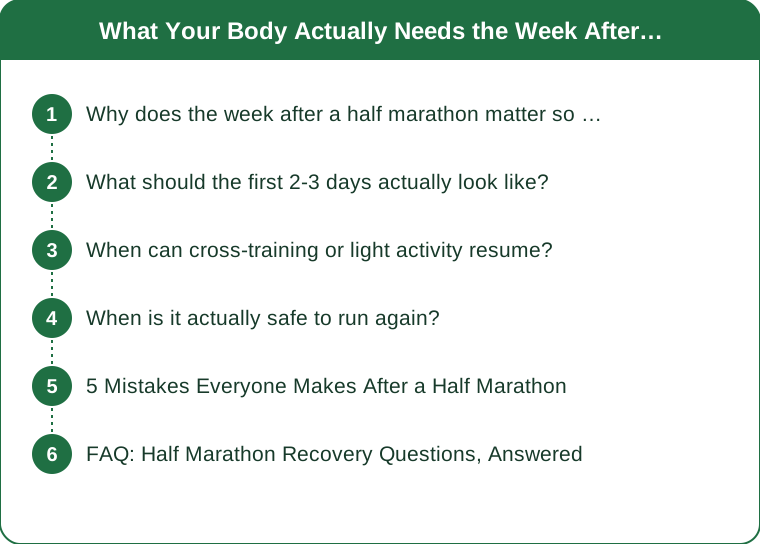
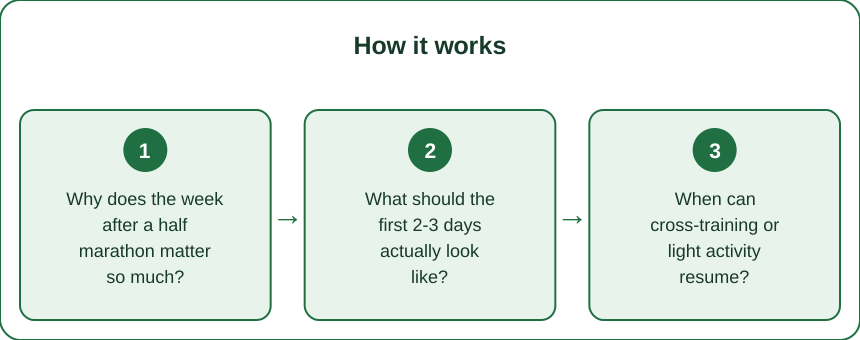
Why does the week after a half marathon matter so much?
Thirteen-plus miles of repeated impact creates real microscopic muscle damage, and how that week is handled affects both how fast you feel normal again and whether you’re setting up an overuse injury by returning to training too soon on tissue that hasn’t finished repairing.
What should the first 2-3 days actually look like?
Complete rest or very light walking only — no easy jog, no cross-training yet. This is when the bulk of muscle repair happens, and inserting even “easy” exercise here can meaningfully slow that process down rather than speed recovery up.
When can cross-training or light activity resume?
Around day 4-5, low-impact options like swimming, cycling, or a gentle yoga session support blood flow and recovery without adding new impact-related micro-damage on top of what’s still healing from race day.

When is it actually safe to run again?
Most runners can return to easy, short running around day 7-10, though this varies with individual recovery and race intensity — the key marker is that everyday soreness (stairs, sitting down) should be fully gone before adding running back, not just “mostly gone.”
5 Mistakes Everyone Makes After a Half Marathon
1. Running again within 2-3 days because “it feels fine.” Feeling fine at rest doesn’t mean impact-ready tissue.
2. Skipping hydration and nutrition follow-through. Glycogen and fluid replacement in the days after matters as much as during the race itself.
3. Doing a hard workout the following weekend. A full week of recovery is a minimum, not a suggestion, for most recreational runners.
4. Ignoring lingering soreness past day 5-6. Persistent, worsening soreness (versus normal fading soreness) is worth checking rather than pushing through.
5. Comparing recovery timelines to elite runners. Elite athletes often have different training bases and support systems — a slower recovery timeline as a recreational runner isn’t a failure.
FAQ: Half Marathon Recovery Questions, Answered
How sore is normal after a half marathon?
Moderate soreness lasting 3-5 days, gradually improving each day, is typical — soreness that worsens or doesn’t improve by day 5-6 is worth paying attention to.
Can I do yoga the day after a half marathon?
Gentle, restorative yoga is usually fine even the day after, as long as it avoids deep stretching of already-strained muscle tissue.
When should I schedule my next hard training run?
Most recreational runners do well waiting a full 7-10 days minimum before any hard effort, using the days between for easy movement only.
TL;DR:
- Days 1-3: rest or gentle walking only, no exercise
- Days 4-5: light cross-training (swim, bike, gentle yoga)
- Days 7-10: return to easy running once daily soreness is fully gone
- Persistent worsening soreness past day 5-6 deserves attention
This is general information, not medical advice.
Keep Reading
This article is for general informational purposes only and is not medical advice. Always consult a qualified health professional for guidance specific to you.