You Had to Cut Your Long Run Short. Does It Matter?
Quick Answer: A single shortened long run costs very little. Training adaptation comes from the accumulation of weeks, not from any one session, and a run that reached 70 percent or more of the planned distance delivered most of the intended stimulus. Do not try to make it up later in the same week — squeezing a replacement long run into a week that is already loaded is the most common route to injury in half marathon training.
You planned 16km, you got 10, and now the whole plan feels compromised.
It is not. Here is how much it actually matters and what to do next.

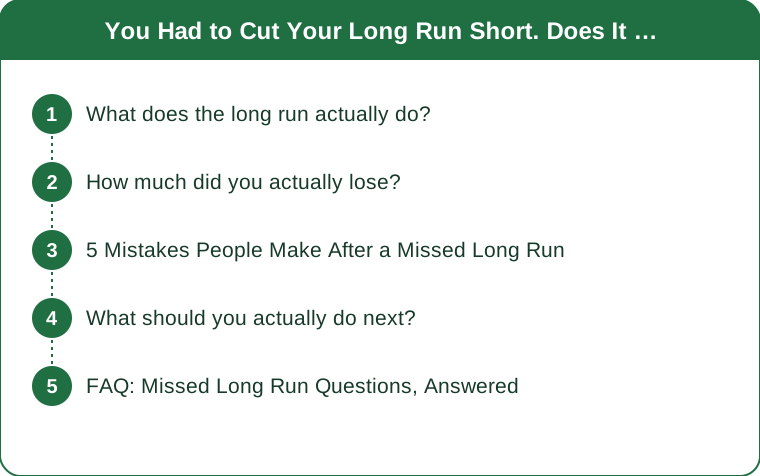
What does the long run actually do?
Several adaptations, and most of them are driven by cumulative weekly volume rather than by any single session.
It builds aerobic capacity and endurance through mitochondrial density, capillary growth and improved fat oxidation. These adaptations respond to total training load over weeks and months, which is why consistency matters more than any individual run.
It builds musculoskeletal durability. Tendons, ligaments, bone and connective tissue adapt slowly to repeated loading, and time on feet is what drives it. This is the adaptation most specific to long runs, and it is also the one that adapts most slowly and is most easily overloaded.
It rehearses fuelling and pacing. For a half marathon, the long run is where you practise your race-morning routine, your gels, your drinks and your pacing discipline. This is a skill component, not a fitness one, and it is worth protecting for that reason.
It builds psychological confidence — knowing you have covered a distance close to race distance. This matters more than people admit and is the most common reason a missed long run feels so significant.
None of these are undone by one shortened session. Fitness does not evaporate in a week, and a single interruption in a 10 to 14 week block is statistically noise. What matters is whether it becomes a pattern.
How much did you actually lose?
It depends almost entirely on how far you got, and the thresholds are more forgiving than people assume.
If you got 70 percent or more of the planned distance, you got most of the stimulus. The final portion of a long run has some specific value — running on tired legs is part of the point — but the aerobic and structural work happened.
If you got about half, you completed a solid moderate run. That is a real training session, not a failure, and it contributes to weekly volume normally.
If you got very little or nothing, one missed session in a training block still has minimal effect on race day, provided the surrounding weeks are intact.
What matters far more is why it was cut short. A time constraint is a scheduling issue with no physical consequence. Cutting it short because of pain, unusual fatigue or illness is information about your body, and continuing as if nothing happened is the actual risk.
Two or three consecutive weeks of missed long runs is a different situation. At that point the pattern is worth addressing — either the plan is too ambitious for your life, or something is wrong. Neither is solved by heroically making up the deficit in one week.
Where a long run genuinely matters most is in the mid-block weeks where you build to your longest distance, roughly three to five weeks before race day. Missing one there is worth adjusting for. Missing one in the first fortnight or during taper is close to irrelevant — and missing a taper long run is arguably beneficial.

5 Mistakes People Make After a Missed Long Run
1. Cramming it into the next available day. The most common and most harmful response. A long run two days after a hard session, in a week already carrying its normal load, spikes weekly volume and compresses recovery. Running injuries cluster around exactly this pattern — a sudden jump in load relative to recent training.
2. Adding it on top of next week’s long run. Doing 16km this week and 20km next week when the plan said 16 and 18 is a much bigger jump than it looks, and it lands in a week that was already designed to be harder.
3. Running the replacement too fast. There is a tendency to compensate for a shorter run with more intensity. This changes the session’s purpose entirely — an easy long run and a hard tempo run produce different adaptations, and swapping one for the other means you did neither.
4. Panic-adding distance for several weeks. One missed session becomes a fortnight of overreaching, which is how a minor scheduling problem turns into a genuine injury. Trust the plan you had.
5. Abandoning the block entirely. The opposite failure, and it is more common than people admit. One missed run leads to a sense that the plan is ruined, which leads to another missed run. The most valuable thing you can do after a disrupted session is to do the next scheduled session exactly as written.
What should you actually do next?
Almost always: nothing special. Run the next session as planned.
Continue the plan from where you are. This is genuinely the right answer in the large majority of cases, and it is unsatisfying precisely because it feels like doing nothing.
If you want to recover some volume, add it gently to easy runs. An extra 2 or 3km spread across two easy runs later in the week is a low-risk way to recoup some load without creating a spike.
If the missed run was in a critical build week, consider swapping the next two weeks so that the longest run comes a week later. This shifts the block rather than compressing it, and it is far safer than doubling up.
Keep the weekly increase reasonable. A commonly cited guideline is not increasing weekly volume by more than about 10 percent, and while the evidence for that exact number is thinner than its popularity suggests, the principle — avoid sharp jumps — is well supported.
If you cut it short due to pain, address that first. A niggle that stopped a run and then gets loaded with a make-up session two days later is how a minor problem becomes a six-week problem.
Protect the rehearsal, not the distance. If what you missed was your last chance to practise race fuelling, work that into a shorter run instead. You can rehearse gels and drinks over 12km perfectly well.
Adjust the plan to your actual life. If long runs are regularly getting cut, the plan does not fit your schedule. A plan built around a 90-minute long run that you complete every week is better than one built around a two-hour run that you finish half the time.
A seasonal note worth planning around: with sunrise arriving later each week, early morning long runs are increasingly starting in the dark, and this is exactly the period when weekend long runs start getting cut short for daylight and weather reasons. Moving the long run to a different day, or committing to a head torch and reflective kit now, prevents a pattern of shortened runs over the next two months.
If you are cutting runs short because of persistent pain rather than time, that is worth seeing a physiotherapist about. This is general information, not medical advice.
FAQ: Missed Long Run Questions, Answered
Will one short long run affect my race time?
Essentially no. Race performance reflects months of accumulated training. One session is within the normal variation of any training block.
Should I do the long run on a weekday instead?
Only if it fits without compressing your recovery. Moving it to a day with a rest day either side is fine; slotting it between two hard sessions is not.
How many long runs can I miss before it matters?
As a rough guide, missing more than two or three in a 12-week block starts to show, particularly if they are the longest ones. One or two is noise.
Is it better to run shorter and faster to compensate?
No — they train different things. If you have limited time, a shorter easy run preserves the purpose of the session better than a shorter hard one.
What if I keep missing them?
Change the plan, not your willpower. A realistic plan completed consistently outperforms an ambitious one completed sporadically, and the difference on race day is substantial.
Does the longest run need to be close to race distance?
Many half marathon plans peak somewhere in the 16 to 19km range rather than at the full 21.1km, and that works well. You do not need to have covered race distance in training to complete a half marathon.
TL;DR:
- Adaptation comes from accumulated weeks, not one session. A single shortened long run is noise.
- If you got 70 percent or more of the distance, you got most of the stimulus.
- Do not cram it in later that week. Sudden load spikes are where running injuries cluster.
- Run the next scheduled session exactly as written. That is genuinely the right answer.
- If it was cut short by pain rather than time, that is information — deal with it before adding load.
If long runs keep getting cut, change the plan to fit your life. Consistency beats ambition every time.
Keep Reading
This article is for general informational purposes only and is not medical advice. Always consult a qualified health professional for guidance specific to you.