Half Marathon Carb-Loading Is Mostly Unnecessary — Here's What Actually Helps Race Day
Quick Answer: A half marathon burns through glycogen stores far less aggressively than a full marathon, so a multi-day carb-loading protocol is unnecessary — one normal-to-slightly-higher carb dinner the night before and a familiar carb-based breakfast 2-3 hours pre-race covers what the body actually needs.
The pasta dinner the night before a half marathon has become a ritual more than a requirement. Most runners over-plan this part and under-plan the part that actually matters more: race-morning timing.

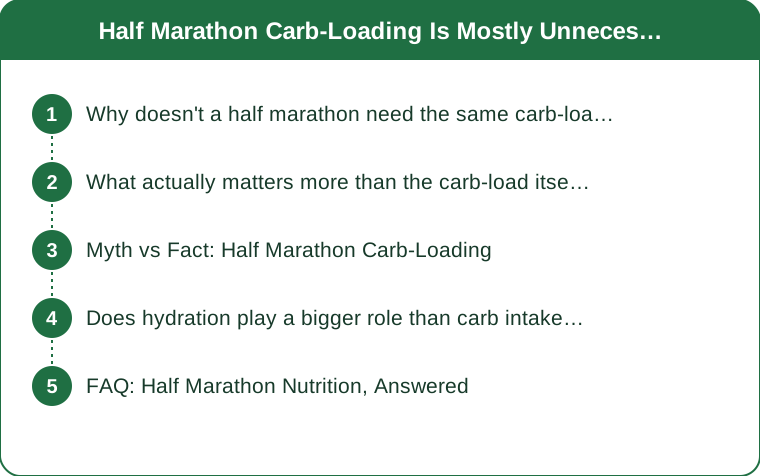
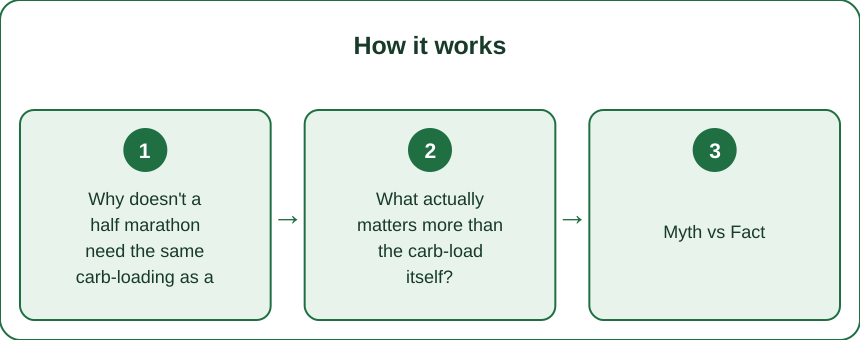
Why doesn’t a half marathon need the same carb-loading as a full marathon?
Marathon-distance carb-loading exists because glycogen stores typically run low around mile 18-20 of a full 26.2-mile race. A half marathon’s 13.1 miles rarely depletes glycogen that severely for most runners, meaning the 3-day loading protocols built for marathoners are solving a problem the half marathon distance usually doesn’t create.
What actually matters more than the carb-load itself?
Race-morning timing matters more than most runners realize. Eating a familiar, carb-based breakfast 2-3 hours before the start gives the body enough time to digest while still having usable glucose available at the starting line — this single window affects performance more than anything eaten two nights prior.

Myth vs Fact: Half Marathon Carb-Loading
Myth: Eating a huge pasta dinner the night before guarantees better energy on race day. Fact: Overeating the night before more often causes GI discomfort at the start line than it improves performance.
Myth: Skipping breakfast entirely is fine if dinner was carb-heavy. Fact: Glycogen stored the night before is largely used up overnight — race-morning fuel is a separate, necessary input.
Myth: New pre-race foods should be tried on race morning to “maximize” fueling. Fact: Race morning is the worst time to test anything new — familiarity matters more than optimization.
Does hydration play a bigger role than carb intake for this distance?
For many runners, yes — under-hydration in the 24 hours before a half marathon shows up as fatigue and cramping more consistently than under-fueling does. Steady water intake the day before, rather than a large volume right before the start, tends to work better.
FAQ: Half Marathon Nutrition, Answered
Should the pre-race dinner be different from a normal dinner?
Only slightly — a familiar meal with a bit more carbohydrate and less fat or fiber than usual (to avoid GI issues) works better than a dramatically different “carb-load” meal.
Is a sports drink necessary the morning of a half marathon?
Not required, though a small amount of easily digestible carbohydrate (banana, toast, or a sports drink) 2-3 hours out helps top off glycogen without causing stomach discomfort.
Does alcohol the night before actually matter for a half marathon?
Yes — even moderate alcohol impairs hydration and next-day glycogen replenishment, making it one of the more overlooked factors in half marathon prep.
TL;DR:
- Half marathons rarely deplete glycogen enough to require true multi-day carb-loading
- Race-morning timing (2-3 hours before, familiar food) matters more than the night-before meal
- Steady hydration the day before beats a big water dose right before the start
- Skip new foods on race morning — familiarity protects against GI surprises
The pasta dinner isn’t the mistake. Treating it as the whole strategy is.
Keep Reading
This article is for general informational purposes only and is not medical advice. Always consult a qualified health professional for guidance specific to you.